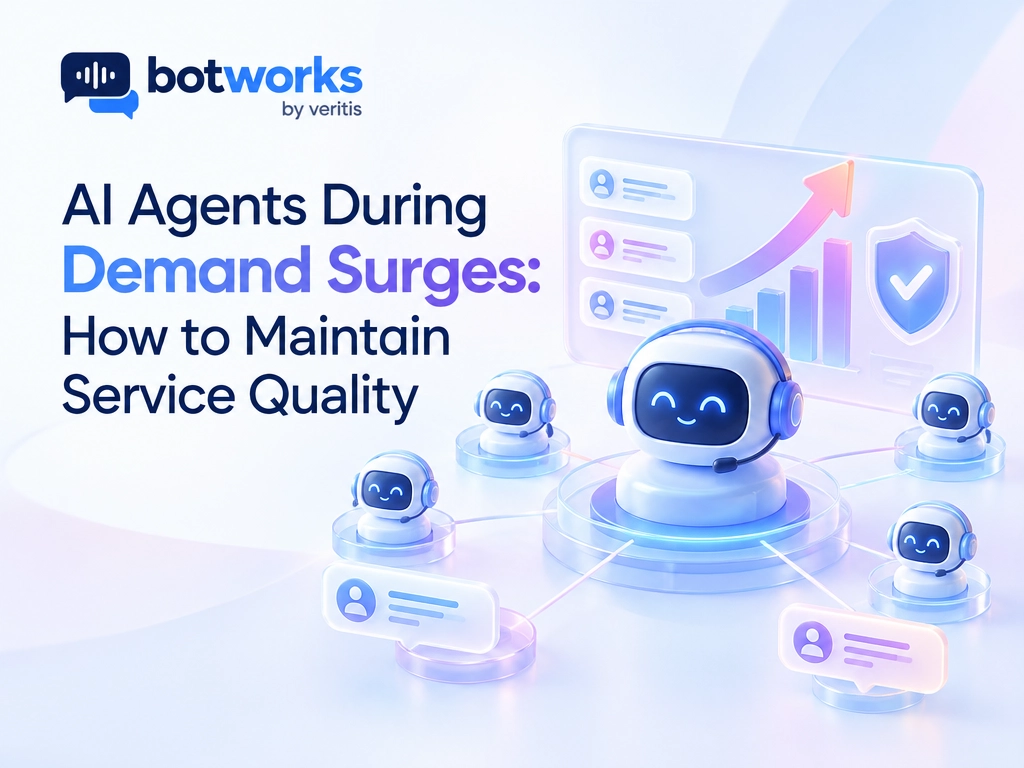
AI agents during demand surges maintain service quality by combining scalable conversation handling with approved knowledge, bounded actions, and timely human escalation.
When customer inquiries spike, answering faster is not enough. Customers still need accurate information, completed requests, and access to human judgment when necessary.
Get Started with AI AgentsWhat is a Customer Service Demand Surge?
A demand surge occurs when incoming requests exceed normal handling capacity. Common triggers include:
- Seasonal peaks: Holiday shopping, enrollment periods, and tax deadlines.
- Product launches and promotions: Questions about availability, eligibility, orders, and returns.
- Service outages and disruptions: Customers seeking status updates and recovery options.
- Billing and policy changes: Confusion about charges, renewals, or revised terms.
- Unexpected market events: Sudden developments that change customer needs without warning.
Predictable peaks allow advance planning. Unexpected events require predefined response and fallback procedures.
How Do Demand Surges Affect Service Quality?
Queues grow when arrivals outpace completed requests. Longer waits can increase abandonment and leave customers uncertain about next steps.
Human agents face heavier workloads, while rushed responses and outdated guidance can produce inconsistent answers. Customer satisfaction can suffer even when the initial acknowledgment is fast, especially if customers must repeat information or contact support again.
The objective is reliable resolution, not simply more conversations handled.
How Do AI Agents Manage High Conversation Volumes?
AI agents can support simultaneous conversations, provide immediate first responses, resolve routine requests, and remain available outside staffed hours. Their capacity still depends on model quotas, retrieval services, telephony, and enterprise systems.
Load balancing, request limits, and circuit breakers can help manage traffic and contain failures in connected services. Teams should test these controls across the full workflow, including retrieval, telephony, and downstream business systems.
Effective surge handling also requires:
- Prioritization: Reserve capacity for urgent needs rather than treating every request equally.
- Approved actions: Complete eligible tasks, such as account updates, only after required verification.
- Bounded retries: Use exponential backoff with jitter instead of repeatedly overwhelming a failing service.
- Graceful degradation: Offer verified information, defer unavailable actions, or arrange follow up when full service cannot continue.
Continuous availability does not guarantee every transaction remains executable during an outage.
Protect downstream systems as well as conversation capacity. If an order system slows down, limit repeated status requests and explain when a transaction cannot be completed. Never confirm an action until the connected system verifies its outcome.
How Do AI Agents Resolve Requests During Demand Surges?
Resolution requires a verified outcome, not just an answer. Define executable workflows for each eligible intent:
- Order Inquiries: Verify identity, retrieve current order status, and offer only available delivery or cancellation options.
- Billing Questions: Retrieve the relevant charge, explain approved policy, and route disputed adjustments for authorization.
- Service Disruptions: Retrieve approved incident updates, distinguish known outages from individual faults, and create a case when needed.
Never confirm a refund, booking, or account change until the connected system confirms completion.
Start automation with frequent requests that have clear policies, reliable system access, and outcomes that can be verified. Keep disputed adjustments, sensitive decisions, policy exceptions, and unresolved identity concerns with human teams.
How Can Teams Maintain Response Quality During Demand Surges?
Volume controls protect responsiveness. Separate controls protect correctness:
- Approved Enterprise Knowledge: Retrieve current procedures and incident updates from governed sources.
- Consistent Policies: Apply the same eligibility, verification, and approval rules at every volume level.
- Intent Understanding: Distinguish an information request from a transaction, complaint, or urgent issue. Clarify ambiguity before acting.
- Preserved Context: Retain relevant details, completed steps, and tool results without exposing unnecessary personal information.
- Channel Accuracy: Keep Chat and Voice aligned with the same approved guidance and live system records.
Reduced functionality must never mean reduced safety. Apply AI governance in customer service through least privilege access, identity verification, approved tool permissions, and audit records. Treat customer messages and retrieved content as untrusted inputs, not authorization to change policy or execute tools.
Escalate when requests exceed the agent’s approved scope, require judgment, involve sensitive decisions, or remain unresolved after bounded attempts. Honor explicit requests for human assistance.
Transfer the conversation summary, verified identity status, relevant records, attempted actions, and reason for escalation. This gives human agents useful information without forcing customers to restart.
Prevent unnecessary transfers by clarifying intent or requesting a narrow human approval when policy permits. Human capacity is finite, so routing must reflect skills, availability, queue ownership, and realistic response expectations.
How Should Teams Prepare AI Agents for Demand Surges?
Use this sequence before expanding automated service:
A) Forecast Volume: Estimate requests by channel, intent, timing, and expected handling complexity using previous peaks and planned events.
B) Update Knowledge: Validate policies, incident messaging, ownership, and effective dates.
C) Test Realistic Scenarios: Include traffic bursts, ambiguous requests, unavailable tools, incorrect retrieval, and repeated contacts.
D) Define Escalation Rules: Specify risk thresholds, destination queues, approvals, and behavior when humans are unavailable.
E) Validate System Capacity: Test model quotas, concurrent calls, retrieval, APIs, and downstream transaction limits together.
For Botworks Voice, test interruptions, recognition errors, silence, and failed transfers under load. For Botworks Chat, test abandoned sessions and customers returning through another channel. Track deferred requests, assign an owner, and set a clear expectation for customer follow up.
Assign an incident owner and define activation thresholds for queue delays, tool failures, and resolution quality. Pilot approved workflows before expanding coverage. After recovery, reconcile deferred requests, check for duplicate actions, and review failed conversations before restoring normal operating settings.
A surge readiness test should confirm that the agent handles increased demand and system failures safely. Set pass criteria in advance for policy compliance, confirmed outcomes, human handoffs, and recovery of deferred requests. Compare these criteria with customer service SLA targets.
How Should Teams Measure Service Quality During Demand Surges?
Compare peak performance with normal periods, segmented by channel and request type. Measure completed outcomes rather than conversation volume alone.
| Metric | What to measure |
| First response time | Time to useful help, separate from an acknowledgment |
| Verified resolution rate | Eligible requests completed with system confirmation or a quality check |
| Repeat contact rate | Customers returning about the same unresolved issue within a defined period |
| Escalation accuracy | Whether transfers were necessary and reached the right team |
| Customer satisfaction | Feedback across automated resolutions, human handoffs, and deferred requests |
| Cost per verified resolution | Model, telephony, integration, human handling, and repeat contact costs |
Track queue delays, tool failures, fallback frequency, and slow completion times to identify the causes of performance problems. Define metric denominators and review periods before reporting. A conversation that ends without a transfer is not necessarily resolved.
Compare similar request types across peak and normal periods. Report automated resolutions, human assisted resolutions, deferred requests, and unresolved contacts separately to avoid misleading averages.
How Does Botworks Support Surge Management?
Botworks describes its enterprise AI customer service approach through scalable Chat and Voice support, immediate responses, automated request resolution, intelligent human escalation, and continuous performance visibility.
Its AI customer service platform positions automation around understanding intent, taking approved actions within defined business rules, and escalating when judgment is required. Assess these capabilities against your actual peak workloads, security requirements, and resolution targets before rollout.
Conclusion
Resilient service combines scalable capacity with governed knowledge, bounded actions, and prepared human teams. Understand the customer, take the right action, resolve the issue, and measure the outcome.
Book a consultation with Botworks to assess your peak service workflows and define a path forward.
Talk to AI ExpertsFrequently Asked Questions on Demand Surges
What Causes Customer Service Demand Surges?
Seasonality, promotions, launches, outages, billing changes, policy updates, and unexpected market events can push incoming requests beyond normal handling capacity.
How Do AI Agents Handle Sudden Volume Increases?
AI agents can handle concurrent conversations, prioritize requests, automate routine tasks, and use controlled fallbacks. Effective capacity still depends on connected systems, model limits, and available human support.
Can AI Agents Maintain Response Quality at Scale?
They can when approved knowledge, validation, context management, and capacity controls are configured and tested together. Higher conversation capacity does not remove the need to verify completed actions.
When Should AI Agents Escalate Conversations?
AI agents should escalate when risk, complexity, customer preference, or required approvals exceed their authorized scope. The handoff should include relevant context and attempted actions so the customer does not need to restart.
Which Metrics Measure Service Quality During Surges?
First response time, verified resolution rate, repeat contact rate, escalation accuracy, and customer satisfaction measure different aspects of service quality. Operational diagnostics help explain performance changes.
What should an AI agent do when a connected system is unavailable?
It should explain the limitation, provide verified information, and defer the affected action or escalate according to policy. It should not claim completion without confirmation, and deferred requests should remain tracked through recovery.