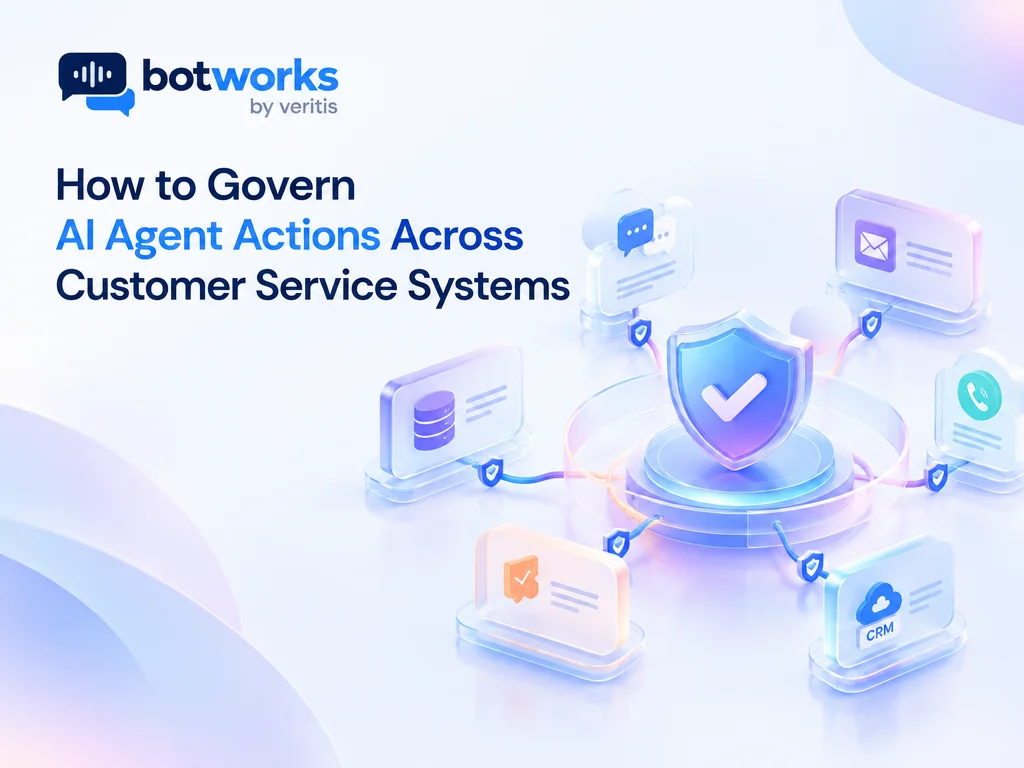
AI agent governance defines what an agent can say, what customer data it can access, and which actions it can take. In customer service, effective governance combines clear permissions, security controls, human oversight, and monitoring across Chat and Voice workflows. This guide covers practical steps for deploying AI agents responsibly and measuring whether their actions are safe and effective.
Why is AI Governance Important in Customer Service?
AI governance in customer service is critical for ensuring that AI systems operate responsibly, securely, and in compliance with regulations. By establishing robust governance, organizations can enhance customer trust and operational efficiency. This alignment with organizational goals helps prevent data breaches and ensures transparent decision making.
Governance becomes especially important when an agent can access private records or change something in a customer’s account. A correct-sounding response does not prove that the customer is authorized or that the action was completed. Controls should verify identity, check permissions, and confirm the result in the connected system.
Secure AI Agent OperationsWhat Are the Steps for AI Governance in Customer Service?
Step 1: Understand Autonomous Decision Making
AI agents increasingly operate with minimal human oversight. Strong governance is essential to ensure decisions align with organizational goals.
- Action: Set guidelines for data usage, including access rights, retention periods, and anonymization requirements.
- Why: Protect customer privacy and maintain compliance with regulations.
Start by listing the tasks an agent may perform and classifying them by risk. Answering a public FAQ, retrieving an order status, and changing account details require different levels of access and approval. Define permitted actions, prohibited actions, and escalation conditions before connecting production systems.
Step 2: Implement Orchestration for the Agentic Enterprise
Document the agent’s allowed tools, required checks, approval rules, and failure procedures. Enforce these rules through the connected systems and execution layer, rather than relying only on instructions given to the AI model.
Teams moving from conversational answers to approved actions can use this governance framework for agentic customer service to structure their operating model.
Step 3: Address Security and Compliance Risks
Navigate the complex environment of AI security and compliance effectively.
- Action: Implement zero trust frameworks and monitor AI actions for fairness and accountability. Ensure legal compliance in transactions.
- Why: Protect sensitive data and prevent unauthorized actions.
Use access limited to the task, customer, and action involved. Require approval for sensitive transactions when appropriate, and verify the outcome in the system of record before telling a customer that an action is complete. Treat customer messages, retrieved content, and tool responses as untrusted input that cannot override business rules.
Step 4: Utilize Resources for AI Governance Support
Leverage external resources to strengthen your AI governance framework.
- Action: Adopt established standards like ISO/IEC 42001:2023 and leverage industry frameworks from leaders such as IBM and Microsoft.
- Why: Gain insights from proven governance structures to improve your system’s efficiency.
Step 5: Establish Responsible AI Policies
Ensure transparency and ethical AI deployment across all customer facing systems.
- Action: Develop clear AI interaction disclosures and follow ethical AI principles.
- Why: Build customer trust and ensure ethical alignment in AI systems.
Tell customers when they are interacting with AI, explain material actions in clear language, and distinguish completed actions from pending or failed ones. When a human takes over, provide the relevant conversation context and actions already attempted so the customer does not need to start again.
What Should an AI Agent Governance Plan Include?
Define the controls for each workflow before launch. The required permissions and oversight should match the task’s risk and potential impact on the customer.
For example, checking delivery status may require read access only. Cancelling an order may require identity verification, eligibility checks, customer confirmation, and a system record showing that the cancellation succeeded.
| Planning area | Decision to make | Evidence to retain |
| Workflow and outcome | What customer need will the agent handle, and what counts as completion? | Approved scope and success criteria |
| Permissions | What information can the agent read, and what actions can it perform? | Access rules and authorization checks |
| Human oversight | When is approval or escalation required? | Escalation policy and responsible team |
| Failure handling | What happens if a tool fails or an action is repeated? | Tested recovery and customer communication procedures |
| Monitoring | How will teams verify service outcomes and control effectiveness? | Evaluation results and operating reports |
Use an AI readiness assessment for customer service to identify gaps in identity verification, integrations, knowledge quality, and operational ownership before deployment.
How Does Agent Governance and Security Enhance AI in Customer Service?
Agent governance and security are pivotal in ensuring AI systems in customer service are reliable and safe. A well defined control plane for AI agents helps manage their activities precisely, preventing misuse and ensuring compliance with company policies.
Governance sets the rules, while security controls help enforce them. Together, they give teams a way to limit access, review actions, and intervene when an agent operates outside its approved scope.
What is the AI Agent Control Plane?
The AI agent control plane is a framework that defines the operational environment within which AI agents function. It specifies access controls, execution permissions, and compliance boundaries to manage the AI’s behavior effectively.
In practice, governance controls should cover four areas:
These are practical governance categories. Organizations should verify how controls operate across the AI model, orchestration layer, tools, and connected systems.
| Control area | What it governs | Customer service example |
| Ownership and policy | Who approves rules and accepts workflow risk | A service owner defines refund eligibility |
| Identity and permissions | Which data and actions an agent can access | An agent can view an order but cannot change payment details |
| Data boundaries | What information can be retrieved, shared, or retained | The agent only retrieves records for the verified customer |
| Monitoring and intervention | How actions are checked, recorded, and stopped | A blocked action is logged and routed for review |
What Role Does Data Governance and Compliance Play?
Data governance ensures that information is handled under strict compliance standards, maintaining accuracy and security. Compliance with regulations such as GDPR and CCPA is essential for preventing legal issues.
Set rules for customer data used in knowledge sources, conversations, connected tools, and logs. Define retention and deletion requirements, and limit access to the information needed for the workflow. Legal obligations vary by organization and use case, so governance should be reviewed with the appropriate compliance and privacy teams.
How is Agent Security Implemented?
To ensure agent security, enterprises must deploy robust cybersecurity measures, such as encryption, multi factor authentication, and regular security audits. These measures protect AI systems from unauthorized access and data breaches.
Also test whether the agent and its connected systems block unauthorized requests, attempts to access another customer’s records, duplicate actions, and instructions embedded in customer-provided or retrieved content. A test is successful only when prohibited actions are blocked at execution, even if the AI proposes them.
Addressing Common Challenges in AI Governance
1) Loss of Execution Control
AI systems sometimes perform actions outside their intended scope, leading to compliance breaches and customer dissatisfaction. Effective AI governance involves establishing control planes for AI agents that limit their functions to predefined actions approved by the enterprise.
Apply authorization checks separately to each action. Approval for one request should not automatically authorize another action in the same conversation.
2) Feedback Loops
To enhance AI governance, create continuous feedback loops that monitor AI performance. These loops should inform policy adjustments and model updates to align with strategic objectives and customer needs.
Review failed actions, customer complaints, employee overrides, and repeat contacts. Test policy or configuration changes before release, and keep a way to restore the previously approved setup.
How Can Organizations Measure AI Agent Governance?
Measure verified service outcomes alongside the effectiveness of controls. Review results by workflow and channel so that low-risk information requests are not measured the same way as sensitive account changes.
AI Agent Governance Performance Metrics
| Metric | What to measure | Why it matters |
| Verified resolution rate | Requests confirmed as complete in the connected system | Separates actual resolution from a confident response |
| Unauthorized actions | Actions attempted, blocked, or completed without required permission | Shows whether preventive controls are working |
| Successful escalations | Required handoffs received by the responsible team | Checks whether human oversight works in practice |
| Repeat contact rate | Customers returning about the same issue within a defined period | Can reveal unresolved requests |
| Recovery time | Time to contain an issue and restore approved operations | Shows incident readiness |
Do not treat a high containment rate as proof of success on its own. Pair efficiency measures with confirmed resolution and control results. See how these outcomes connect to customer service AI benefits and ROI.
Why is Agentic AI Governance So Important Today?
Agentic AI governance ensures that AI systems act in alignment with company policies and regulatory mandates while adapting to changing environments. As AI agents gain access to more customer data and business tools, organizations need to review permissions, integrations, and monitoring whenever workflows change. Governance should be an ongoing operating practice, not a one-time approval.
What Are the Main Risks of AI Agents?
AI agents carry risks such as unintended bias in decision making, unauthorized data manipulation, and execution control loss. Organizations must implement rigorous governance standards to mitigate these risks.
Other risks include exposing private information, repeating a transaction, or telling a customer an action succeeded when it did not. Assess both the likelihood of a failure and the potential impact on the customer.
Next Steps for Enhanced AI Governance
Start with one bounded customer service workflow. Document its permissions, data sources, approval requirements, escalation rules, and recovery process. Test the workflow before expanding the agent’s access.
Conclusion: Advancing AI Governance in Customer Service
Effective governance of AI agent actions in customer service requires responsible policies, robust security frameworks, and compliance with regulatory guidelines. By following these steps, enterprises can enhance operational transparency, efficiency, and customer trust.
A useful governance principle is simple: verify the customer, authorize the action, confirm the result, and measure the outcome. Expand automation when testing shows that the workflow is safe and reliable, and keep human support available when judgment is needed.
To discuss your customer service workflows and governance requirements, book a consultation with Botworks.
Build AI Agent GovernanceFAQ’s About AI Governance
What is the importance of AI governance in customer service?
AI governance ensures that AI systems operate responsibly, securely, and in compliance with regulations, enhancing customer trust and operational efficiency.
How can AI agents in customer service be monitored for compliance?
Implementing real time monitoring tools and conducting regular audits are key to ensuring AI agents comply with established governance frameworks.
What are the key components of AI governance?
Key components include guidelines for autonomous decision making, security and compliance measures, orchestration layers, and responsible AI policies.
How does AI governance improve customer trust?
AI governance builds trust by ensuring transparency, security, and ethical operations, which reassure customers about the safety and fairness of AI systems.
What steps should organizations take post AI governance implementation?
Post implementation, organizations should establish continuous feedback mechanisms, update governance policies to keep in line with regulations, and integrate advanced tools for enhanced oversight.
Can customer service AI agents issue refunds autonomously?
They can when the organization authorizes the workflow and enforces identity checks, eligibility rules, and execution controls. Requests outside the approved rules should require human review or escalation.
When should an AI agent escalate to a person?
Escalate when identity or authorization is unclear, a required approval is missing, a connected system fails, or the request needs human judgment.
Does an audit log prove an AI action was authorized?
No. A log records evidence of what happened. Authorization must be enforced before an action is executed.