AI agents create measurable value in customer service by resolving customer needs, not just answering questions. Across Chat and Voice, they understand intent, retrieve approved knowledge, execute permitted actions, and escalate to human teams when judgment is required. According to 2026 industry benchmarks, enterprises see an average return of $3.50 for every dollar invested, first year cost reductions of 20 to 35%, and payback within 3 to 6 months when AI agents are integrated deeply into service workflows.
As customer expectations rise across digital and voice channels, organizations need more than automated responses. They need intelligent systems that understand intent, access relevant information, support business processes, and move interactions toward resolution. This page covers the core benefits, real examples, key disadvantages, and what successful enterprise deployment looks like.
What is AI in Customer Service?
AI in customer service refers to using artificial intelligence technologies to help manage interactions between businesses and their customers. These AI solutions are built to understand customer requests and deliver appropriate answers, resolve issues, and provide information through automated processes, enhancing the efficiency and quality of service.
Transform Customer Service with AIWhat Are Examples of AI in Customer Service?
The clearest way to understand the value of AI agents is to look at where they operate in practice.
1) AI Chatbots and Conversational Agents
Chatbots are the most familiar example. Early chatbots followed rigid decision trees and matched keywords. Modern AI chat agents interpret natural language, hold context across a conversation, and pull answers from approved knowledge sources. The key distinction is capability: a basic chatbot answers a question, while an AI agent understands the intent behind it, takes an approved action, and confirms the outcome.
2) AI Voice Agents
AI voice agents bring the same intelligence to phone conversations. They recognize spoken intent, collect structured details, complete tasks such as scheduling or service intake, and hand off to a human when a situation calls for empathy or discretion. In one widely cited example, an enterprise deploying voice AI cut average customer wait times by 80%.
3) Agent Assist and Knowledge Tools
AI also supports human agents directly by suggesting responses, surfacing relevant policy, and summarizing long conversations. This reduces handling time and improves consistency without removing the human from the interaction.
4) Conversation Analytics
AI reviews interactions at scale to identify recurring issues, knowledge gaps, and sentiment trends, giving service leaders real time insight that manual review cannot match.
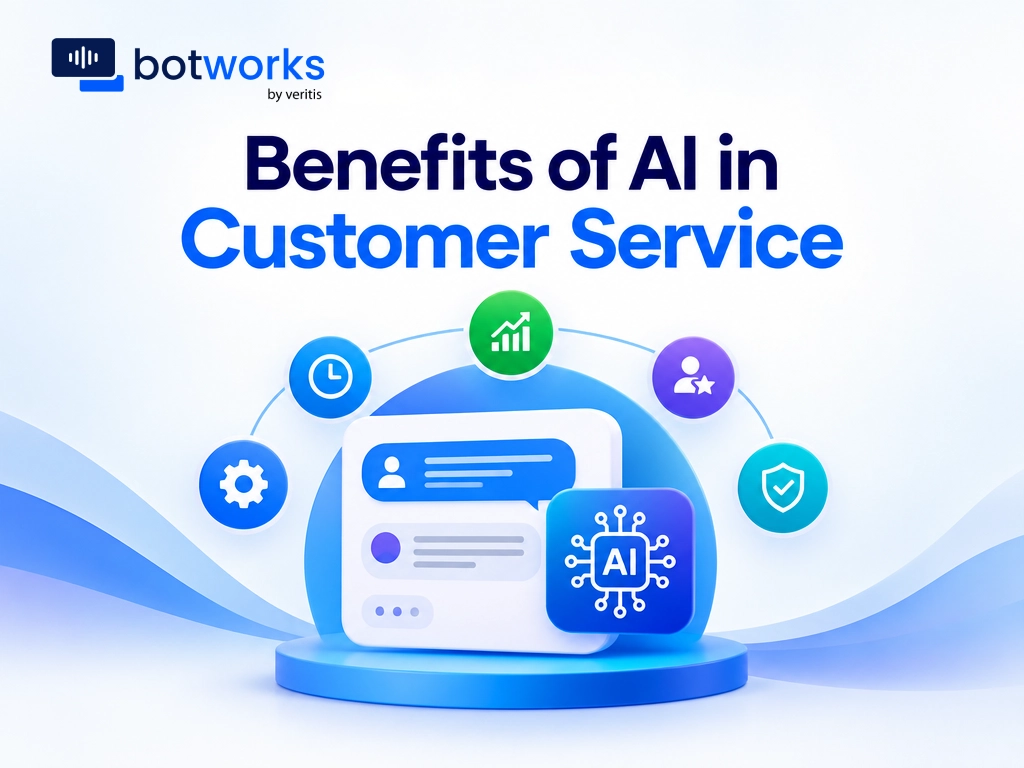
How Do AI Agents Create Value in Customer Service? 8 Key Benefits
The value of AI in customer service extends far beyond faster answers. For executives, the bigger opportunity lies in building a more efficient, measurable service operating model.
1) How Does AI Provide 24/7 Customer Support?
AI enables organizations to provide customer assistance beyond traditional support hours. Customers can access information, initiate service requests, and receive help across Chat and Voice at any hour, without depending on agent availability. This removes queue time as a barrier to resolution.
2) How Do AI Agents Increase Customer Engagement?
AI agents respond instantly and consistently, encouraging customers to self serve instead of abandoning a request. Proactive prompts, guided flows, and always available conversation keep customers moving toward an outcome instead of waiting.
3) How Do AI Agents Maintain Positive Customer Satisfaction?
AI agents use approved knowledge, policies, and business processes to deliver consistent answers across every interaction. This is especially beneficial for organizations with multiple teams, regions, and channels, where inconsistent human answers erode trust.
4) How Do AI Agents Reduce Ticket Resolution Times?
Resolution rate, not deflection, is the true value driver. According to 2026 industry benchmarks, autonomous resolution ranges from 30 to 50% in early deployments, 50 to 70% in mature ones, and 70 to 85% when agents are deeply integrated with enterprise systems. Klarna reported cutting average resolution time from 11 minutes to under 2 minutes after deploying AI agents.
5) How Do AI Agents Facilitate Data Collection and Optimization?
Every conversation generates structured data about customer intent, friction points, and knowledge gaps. AI captures and analyzes this at scale, giving teams the evidence to update knowledge, refine workflows, and prioritize improvements.
6) How Do AI agents Reduce Support Costs?
Industry benchmarks in 2026 place the cost per interaction for AI agents at roughly $0.50 to $2.00, compared with $6 to $13.50 for a human handled contact, alongside first year cost reductions of 20 to 35%. These savings come from automating high volume, repetitive requests rather than replacing skilled staff.
7) How do AI Agents Aid in Scaling Customer Operations?
Customer interaction volumes rise sharply during growth periods, seasonal demand, product launches, or service disruptions. AI agents let businesses absorb higher volumes without increasing human resources at the same rate, so service quality stays steady under pressure.
8) How Fast Can AI Agents Adapt to Changing Needs?
Because knowledge, policies, and workflows are configurable, AI customer service can adjust quickly when products, pricing, or regulations change. Updates propagate instantly across every conversation, keeping responses accurate as the business evolves.
Better Use of Human Expertise
Automation does not remove the importance of human customer service. Instead, AI handles suitable routine interactions while employees focus on complex cases, exceptions, and conversations where judgment or empathy creates greater value. To understand how AI in customer service drives efficiency and resolution, pair automation with well designed escalation paths.
What is the Real ROI of AI Agents in Customer Service?
The financial case is now measurable, not theoretical. According to 2026 industry benchmarks, enterprises report an average return of $3.50 for every $1 invested, with payback periods of 3 to 6 months, particularly under outcome based pricing where cost aligns to resolved interactions.
Value scales with integration depth. Surface level chatbots deliver limited return. Agents connected to CRM, ticketing, scheduling, and commerce systems reach the higher resolution ranges of 70 to 85 % and unlock the full cost advantage. Resolution rate, not deflection rate, is the metric that determines ROI.
What Are the Disadvantages of AI in Customer Service?
A complete view of AI customer service must acknowledge its limits.
1) Vendor Claims Often Exceed Reality
Independent surveys indicate that traditional self service resolves only about 14% of issues, compared with vendor claims that often cite 65% or higher. Realistic autonomous resolution depends heavily on workflow maturity and integration.
2) Cost Driven Automation Can Erode Quality
The Klarna case is the clearest 2026 cautionary example. After AI handled roughly 2.3 million chats and dramatically cut resolution time, quality concerns led the company to rehire more than 150 human agents by mid 2026. Automation without quality governance weakens customer satisfaction and trust.
3) Organizational Barriers Now Outweigh Technical Ones
Governance ownership, compliance review, and skill gaps stall roughly 79% of organizations’ AI adoption, and only about 20% have achieved enterprise wide scaling.
Human judgment remains essential. Sensitive, emotional, or high stakes situations still require people. The right design routes these to human agents quickly and with full context.
How Do Enterprises Deploy AI Customer Service Agents Successfully?
Successful AI adoption requires clear objectives, reliable knowledge, appropriate integrations, defined controls, and continuous performance management. For a detailed readiness review, see the 5 key considerations for AI agents in customer service.
1) Define Business Objectives First
Identify where AI creates the greatest value, whether that is reducing response times, improving resolution rates, expanding service availability, or reducing repetitive work.
2) Select a Platform Aligned with Your Environment
Evaluate conversational intelligence, Chat and Voice support, workflow execution, integration flexibility, analytics, security, and governance.
3) Connect AI with Existing Systems
Integrating AI with CRM, ticketing, scheduling, and knowledge repositories allows agents to access relevant context and support more complete service workflows. This is also what drives the higher resolution and ROI ranges.
4) Configure Knowledge, Policies, and Actions
Define what information AI agents can access and what actions they can perform. Approved knowledge, business rules, escalation conditions, and workflow permissions create the operational boundaries required for responsible automation.
5) Measure and Optimize Continuously
Key measures include resolution rates, escalation rates, response times, customer satisfaction, and cost per interaction.
Conclusion
AI in customer service delivers the strongest value when it combines intelligent automation with trusted knowledge, connected workflows, clear governance, and human escalation. Botworks brings these capabilities together through enterprise Chat and Voice agents designed to improve resolution, consistency, and operational efficiency while keeping organizations in control.
Boost Customer Service with AIFAQs: AI Customer Service Agents
How do AI agents reduce customer service operating costs?
AI agents manage repetitive, high volume interactions, automate approved workflows, and reduce unnecessary manual handling. According to 2026 industry benchmarks, cost per interaction can fall to roughly $0.50 to $2.00, compared with $6 to $13.50 for human handled contacts, contributing to first year cost reductions of 20 to 35%.
What is the ROI of AI in customer service?
Industry benchmarks in 2026 report an average return of $3.50 for every $1 invested, with payback periods of 3 to 6 months. Returns are highest when agents integrate with enterprise systems and are priced against resolved outcomes rather than message volume.
What are the disadvantages of AI in customer service?
The main risks are overstated vendor resolution claims, quality erosion when automation is driven purely by cost, and organizational barriers such as governance ownership and compliance review that stall roughly 79% of adoption efforts. The Klarna case, where more than 150 human agents were rehired in 2026, illustrates the cost of automating without quality governance.
Can AI agents handle customer service autonomously?
AI agents can independently handle suitable customer interactions within defined business rules and permissions, with autonomous resolution ranging from 30 to 85% depending on maturity and integration. Escalate complex, sensitive, or exceptional situations to human teams.
How does Botworks support AI customer service?
Botworks provides AI customer service agents across Chat and Voice. Its agents understand customer intent, use approved business knowledge, connect with enterprise workflows, support permitted actions, and escalate interactions to human teams when required. You can review verified outcomes in our customer success stories.