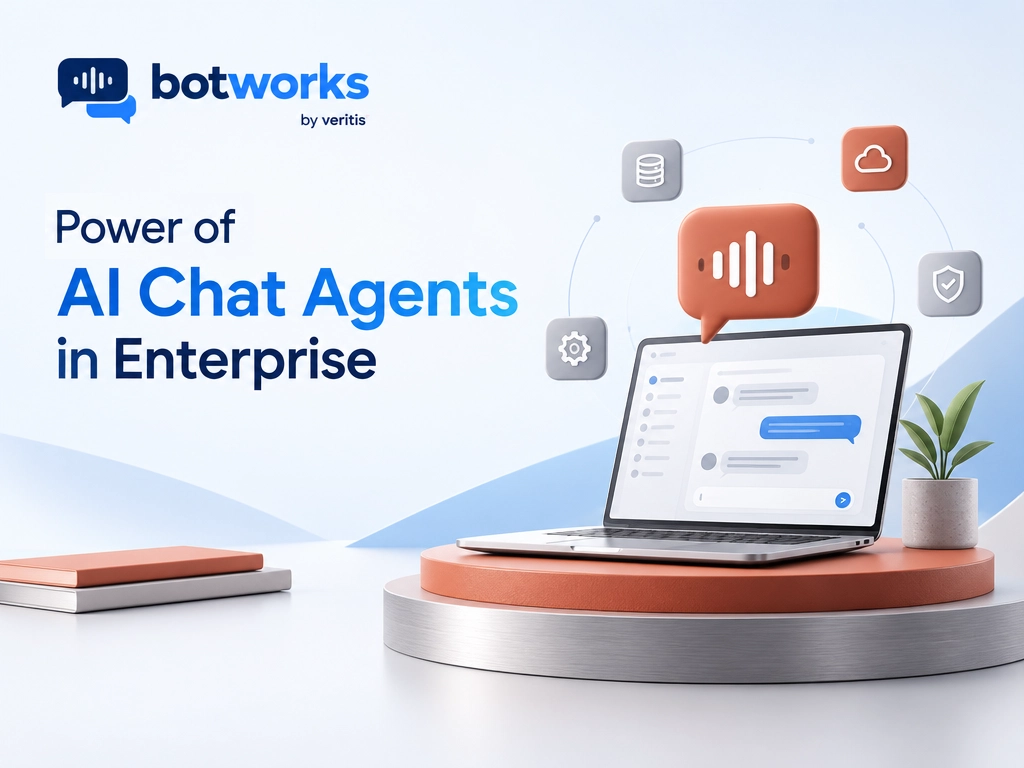
Enterprise AI chat agents help customer service teams resolve requests by understanding intent, retrieving company knowledge, and completing approved actions in business systems. Unlike systems limited to answering questions, they combine conversation with controlled workflow execution and human escalation.
AI chat agents are quickly becoming essential for improving customer service, automating workflows, and strengthening business intelligence across industries. These advanced systems offer capabilities far beyond traditional chatbots, moving toward proactive, intelligent task management. This article explores their strategic adoption, including key use cases, recent innovations, and major industry players.
What Are AI Chat Agents?
AI chat agents are sophisticated virtual assistants designed to autonomously manage and execute a range of tasks across customer service and internal operations. Their defining capability is connecting a customer’s request to relevant information and authorized business actions, rather than producing a conversational response alone. These agents perform multi step workflows, including coordinating meetings, updating records, and generating reports. Enterprise deployment requires clearly defined permissions, reliable information retrieval, and oversight so that agents handle data reading, retrieval, and task execution within approved boundaries.
Transform Enterprise Support with AIHow Do Enterprise AI Chat Agents Work?
An enterprise AI chat agent connects a conversational model to company knowledge, business tools, and operational rules.
- Understand intent: Identify the customer’s goal and collect missing information.
- Retrieve context: Find approved guidance and, when authorized, relevant account details.
- Check permissions: Verify identity, eligibility, and policy requirements before taking action.
- Execute and confirm: Use business system connections to complete approved work and verify the result.
- Escalate when necessary: Transfer unresolved or sensitive requests with conversation history and attempted actions.
Flexible language reasoning should interpret requests, while deterministic checks enforce consequential requirements. A model’s judgment should not override an identity check or refund policy.
How Are AI Chat Agents Different From Traditional Chatbots?
Traditional scripted chatbots generally follow predefined paths and return prepared answers. AI chat agents can interpret varied language, retrieve relevant information, and use connected tools to move a request toward completion.
For example, a chatbot might explain a returns policy. An authorized agent could check an order, verify return eligibility, submit the request, and confirm the result. These capabilities depend on configured integrations and permissions; the label “agent” does not guarantee them.
AWS’s overview of AI agents provides additional context on reasoning, planning, and tool use.
How Are AI Chat Agents Used?
AI chat agents are increasingly integrated into enterprise functions, improving efficiency and productivity.
- Data Analysis and Reporting: Recognized by 60% of organizations as crucial, AI chat agents automate data collection and insight generation, fostering timely and informed decision making. Useful service applications include identifying recurring contact reasons and summarizing unresolved issues. Learn more about AI’s impact on customer service.
- Internal Process Automation: By automating 48% of workflows, agents streamline operations and reduce manual workloads, especially in supply chain management and financial planning. Customer service examples include updating records, checking order status, and routing requests for approval.
What Are Some Industry Specific Applications?
- Banking and Finance: AI agents can support fraud detection and risk management workflows by gathering information and routing suspicious activity for review. Customer service actions require identity verification, controlled account access, and escalation for consequential decisions.
- Healthcare: AI aids clinical documentation, minimizing errors and allowing clinicians to concentrate more on patient care.
- Retail and Manufacturing: These industries utilize AI for marketing, sales, and supply chain management to enhance customer engagement and operational accuracy. Read more on Chat Reduces Support Tickets.
What Are the Recent Innovations in AI Chat Agents?
Recent innovations in AI chat agents are moving enterprise customer service beyond basic question answering toward more autonomous, contextual, and outcome focused interactions.
- Autonomous Resolution: AI chat agents can handle routine customer requests and complete approved tasks with less human intervention.
- Context Aware Conversations: Modern agents can maintain relevant conversation context to provide more consistent and personalized support.
- Intelligent Human Escalation: AI can identify when human expertise is required and transfer interactions while preserving important customer context.
- Enterprise Integration: Chat agents can connect with business systems and workflows to retrieve information and support customer service actions.
- Security and Governance: Enterprise AI agents increasingly require defined access controls, monitoring, auditability, and human oversight for sensitive interactions.
Recent announcements around outcome based pricing, voice orchestration, and connections between agents are market signals, not proof of broad deployment. Enterprises should verify availability and judge these developments by reliable task completion, policy compliance, and safe escalation.
Botworks brings these capabilities together to help enterprises automate customer service, improve resolution efficiency, and deliver secure, consistent experiences across customer interactions.
What Should Enterprises Look for in an AI Chat Agent Platform?
Choosing an AI chat agent platform requires more than evaluating conversational capabilities. Enterprises should consider how effectively the platform can resolve customer needs, integrate with existing systems, maintain security, and support human agents when required.
- Autonomous Resolution: AI agents should handle routine customer requests and complete approved actions with minimal human intervention.
- Enterprise Integration: The platform should connect with existing customer service systems, workflows, and enterprise applications.
- Intelligent Escalation: Complex or sensitive interactions should be transferred to human agents with relevant conversation context preserved.
- Security and Governance: Strong access controls, monitoring, auditability, and data protection should support enterprise requirements.
- Chat and Voice Support: Enterprises should be able to deliver consistent AI driven experiences across conversational channels.
- Measurable Outcomes: The platform should help organizations track resolution efficiency, customer satisfaction, automation performance, and other service outcomes.
Ask vendors to demonstrate failed transactions, conflicting knowledge, unauthorized requests, and attempts to manipulate agent instructions. Confirm data retention rules, access boundaries, and whether logs capture tool actions and outcomes. A convincing demonstration should show when the agent stops, not only when it succeeds.
Botworks combines these capabilities to help enterprises automate customer interactions while maintaining the integration, security, governance, and human oversight required for modern customer service.
Explore how AI Voice Agents support sales operations.
How Should Enterprises Deploy and Measure AI Chat Agents?
Start with a clearly bounded customer need, such as order tracking or appointment changes. Document the approved information sources, required permissions, action sequence, and escalation conditions before connecting production systems.
Test with representative conversations, ambiguous requests, outdated knowledge, and unavailable tools. Release gradually with monitoring and a way to disable actions when problems appear.
Measure verified resolution rather than conversation containment alone:
- Resolution quality: Did the customer’s issue actually get resolved?
- Action accuracy: Did the correct system update occur without duplicate or unauthorized changes?
- Customer experience: Did satisfaction improve, and did customers need to contact support again?
- Operational value: Did cost per resolved request and human handling effort improve?
Define what counts as resolution before comparing vendors, especially when pricing depends on outcomes. Review escalations and repeat contacts alongside automation performance.
Conclusion: Why Embrace AI Chat Agents?
AI chat agents are transformative tools in the enterprise sphere. By understanding customer needs, executing tasks, and resolving issues effectively, they enhance service delivery and operational control. Organizations should use these intelligent agents to improve customer experiences, increase productivity, and meet rigorous security standards. A tailored consultation with AI strategists can help businesses navigate AI opportunities effectively.
Discover more in our insights on Enhancing Customer Service with Chat and Voice AI Solutions.
Optimize Enterprise Chat SupportFAQ’s on AI Chat Agents
What are AI chat agents?
AI chat agents are advanced virtual assistants designed to autonomously manage and execute tasks across customer service and internal operations, improving efficiency.
How do AI chat agents benefit businesses?
They automate workflows, analyze data, and improve customer service, increasing productivity and reducing manual workloads.
What industries are benefiting from AI chat agents?
Industries such as banking, finance, healthcare, retail, and manufacturing utilize AI chat agents for tasks like fraud detection, clinical documentation, and supply chain management.
What are some recent innovations in AI chat agents?
Recent innovations include contextual knowledge retrieval, approved workflow execution, intelligent human escalation, and orchestration across chat and voice. Availability and reliability vary by platform and implementation.
Who are the key players in the AI chat agent industry?
Key industry players include OpenAI (ChatGPT), Google Gemini, Anthropic Claude, Salesforce, ServiceNow, Microsoft, and IBM, advancing AI adoption in enterprises.
Can enterprise AI chat agents replace human customer service teams?
Enterprise AI chat agents can resolve suitable routine requests, but human teams remain essential for sensitive cases, exceptions, and oversight. Effective deployment defines escalation conditions and preserves context so customers do not have to restart their explanation.