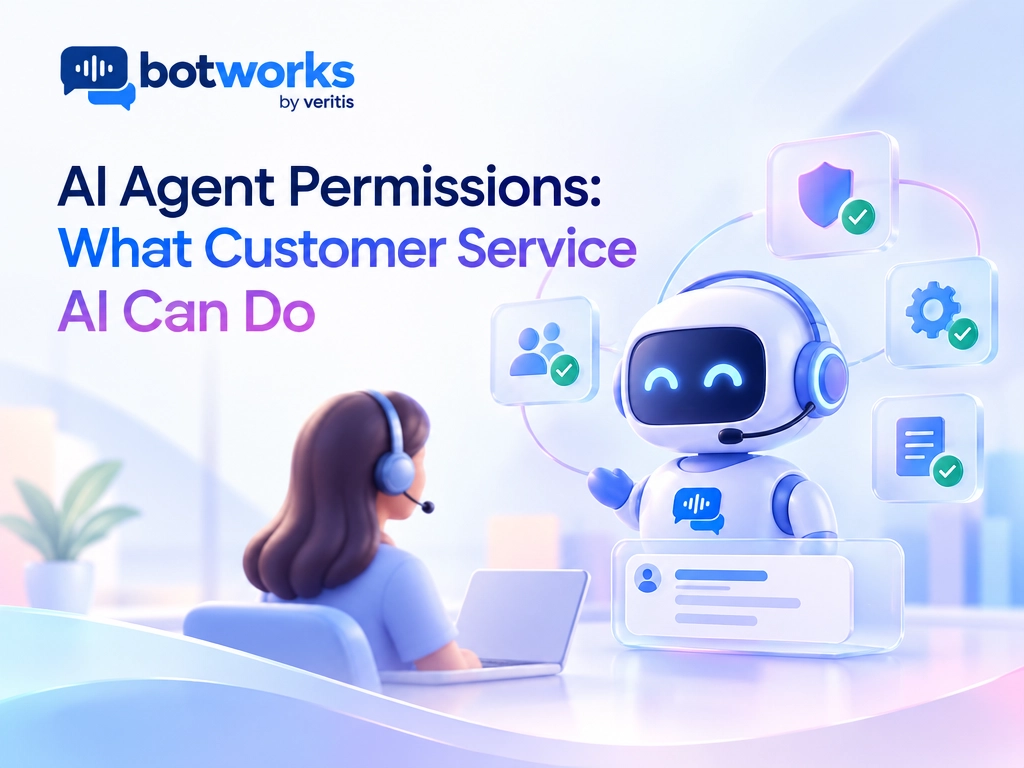
AI agent permissions define which customer service tasks an AI may perform, what data it may access, and when it must seek human approval. The answer depends on defined authority, not conversational confidence. AI agent permissions should allow routine, verifiable service actions while reserving exceptions and consequential decisions for qualified humans.
A customer wants a refund. Your AI agent understands the request and can access the payment system. Should it issue the money, ask for approval, or transfer the conversation?
This guide explains how to establish those boundaries, enforce them across enterprise systems, and measure whether automation actually resolves customer needs.
Manage AI Agent PermissionsWhat Are AI Agent Permissions, and Why Do Boundaries Matter?
AI agent permissions define what an agent may read, disclose, change, execute, and approve. They should specify the customer, system, purpose, conditions, and limits associated with each action.
For example, permission to retrieve an authenticated customer’s order status does not imply permission to access every customer record or change a delivery address.
A useful permission policy distinguishes three things:
- Capability: The system can technically perform an action.
- Authorization: Business rules permit that action in this situation.
- Verified completion: The connected system confirms that the action succeeded.
These distinctions protect customer service AI security and business accountability. Fluent language is not proof of authorization or execution.
In the Air Canada chatbot case, the British Columbia Civil Resolution Tribunal decision awarded damages after a customer relied on incorrect bereavement fare advice. The case illustrates that an agent can create financial exposure through its statements without moving money itself. It does not establish a universal rule that every chatbot promise is enforceable.
Which Actions Can AI Agents Perform Independently?
Use three permission categories: autonomous actions, approval required, and prohibited actions. The following is a recommended operating model, not a universal legal threshold.
Actions Suitable for Independent Execution
Allow bounded tasks when identity, policy eligibility, and system access requirements are satisfied:
- Answer documented questions using approved, current knowledge.
- Retrieve customer specific order, appointment, or service information.
- Guide customers through approved troubleshooting steps.
- Create tickets, classify issues, and update permitted case fields.
- Cancel eligible orders or issue routine refunds within configured limits.
- Collect feedback without exposing unnecessary personal information.
- Provide multilingual support using approved policies, with escalation when language ambiguity affects a consequential request.
These workflows can absorb peak activity, but higher volume must never expand an agent’s authority. When capacity is constrained, queue exceptions rather than bypassing approval.
Adjacent Workflows Need Their Own Boundaries
Data enrichment and personalization should use approved fields for a defined service purpose. Moving service information into targeted marketing requires a separate assessment of permitted use and applicable consent requirements.
An agent may collect lead details and qualify interest against approved criteria, but should not invent pricing, discounts, or contractual commitments.
For internal support, communication, and training, agents can retrieve authorized procedures, draft summaries, and explain workflows. Employee access boundaries must still apply. An internal assistant should not gain unrestricted access to HR records or administrative systems.
Actions That Require Human Approval
Require an authorized reviewer for:
- Refunds above policy limits or outside normal eligibility.
- Sensitive account recovery or ownership changes.
- Exceptional compensation or contractual commitments.
- Disputed identity, suspected fraud, or conflicting evidence.
- Irreversible account changes or consequential eligibility decisions.
Human approval for AI agents must occur before execution when the action requires authorization. Reviewing a completed irreversible action is not an approval control.
Actions Agents Should Never Perform
Prohibit agents from bypassing authentication, granting themselves privileges, revealing another customer’s information, disabling security controls, or treating customer instructions as authority to override policy.
They must not fabricate policies, conceal failures, request passwords or authentication codes through unauthorized workflows, or export sensitive information to unapproved destinations. A customer’s willingness to proceed cannot override these restrictions.
How Do You Enforce AI Agent Access Controls?
The OWASP guidance on excessive agency recommends limiting functionality, permissions, and autonomy. Put enforcement in the application and connected systems, not only in the agent’s instructions.
Apply Role Based Access and Least Privilege
Give each agent only the tools and data needed for its assigned workflow. Separate read permissions from write permissions, scope access to the authenticated customer, and restrict outbound destinations.
A delivery assistant may read shipment status without receiving access to payment details. A refund workflow may execute an eligible transaction without permission to alter refund policy.
Treat retrieved documents, ticket text, and customer messages as untrusted content. Instructions embedded inside them must not expand tool permissions.
How Should Agent Identity and API Permissions Work?
Use a distinct service identity rather than a shared administrator account. Keep credentials out of prompts and use scoped, short lived credentials where supported.
Role based access defines permitted job functions. Attribute based checks add context, such as customer ownership, region, transaction amount, and authentication strength. Each API request must satisfy both the agent’s authority and the customer’s entitlement. Recheck authorization at execution, including after a transfer between AI chat agents and AI voice agents.
Define Approval Rules and Escalation Paths
For every action, document:
1) The permitted business purpose and responsible owner.
2) Required authentication and eligible customer records.
3) Transaction limits, cumulative limits, and prohibited conditions.
4) The reviewer, approval criteria, and response expectations.
5) The fallback when approval or a connected service is unavailable.
For example, an illustrative refund rule could permit refunds up to $50 to the original payment method, subject to eligibility and a cumulative limit. Larger or exceptional requests go to a designated reviewer. The amount is a policy example, not an industry standard.
Backend logic should enforce these checks. Use idempotency controls to prevent retries from creating duplicate transactions. Approval should apply to a specific action and amount, not provide blanket authority.
Make Human Handoffs Operational
Escalate customer requests with repeated failures, unclear policy, suspected fraud, or unresolved disputes. Sentiment analysis can help prioritize frustration, but it should not replace identity checks or determine entitlement.
Transfer the customer goal, verification status, conversation summary, attempted actions, system results, and unresolved question. Establish one conversation owner and explain whether the next step is a live transfer, callback, or ticket.
The CFPB report on chatbots in consumer finance warns about repetitive loops and failures to recognize disputes. Preserve original complaints and applicable deadlines rather than forcing customers to restart.
Applicable duties vary. Consumer protection, privacy, accessibility, and sector rules still apply. GDPR restrictions on certain significant automated decisions and EU AI transparency requirements also require assessment where relevant. No single universal rule requires human approval for every customer service response.
How Do You Revoke Permissions Safely?
Assign an owner to each permission and remove access when its workflow ends. Revoke credentials, disable affected tools, and cancel pending approvals when an incident or policy change invalidates authority. Test that suspended agents cannot execute queued actions. This permission lifecycle belongs within your broader AI governance in customer service.
How Do You Monitor Permissions and Govern AI Actions With BotWorks?
Track Execution and Resolution
Maintain real time ticket tracking so teams can see whether a request is awaiting approval, executing, failed, or resolved. Do not close a ticket solely because the agent said it completed the action.
Record the requested action, relevant policy version, permission decision, approval identity, tool call, system result, and escalation outcome. Protect logs with access restrictions, appropriate retention, and minimization of sensitive data.
Measure verified resolution, repeat contacts, unauthorized action attempts, duplicate transactions, handoff quality, customer feedback, and approval delays. Review patterns by workflow, language, and channel. Use findings to improve knowledge and controls, not automatically expand permissions.
Test denial scenarios before launch, including failed authentication, malicious ticket instructions, unavailable reviewers, and system outages. Ensure operators can suspend risky actions while preserving a human service route.
Conclusion
BotWorks positions its enterprise AI customer service platform around understanding customer intent, connecting with enterprise systems, taking approved actions, and escalating when human judgment is required across Chat and Voice.
Explore the BotWorks platform with your authority matrix in hand. Ask to see how your proposed workflows handle permission denial, approval, failed execution, and handoff. Validate implementation details rather than assuming every control is enabled by default.
To see AI agents in action, request a demonstration built around one routine resolution and one policy exception.
Protect AI Agent AccessFrequently Asked Questions on AI Agents Permissions
Can an AI Customer Service Agent Issue Refunds?
Yes, within explicitly configured eligibility, identity, payment destination, and transaction limits. Exceptions should require authorized human approval.
Is a Prompt Enough to Enforce Permissions?
No. Prompts guide behavior, but applications, APIs, and authorization systems must independently enforce access and execution limits.
How Often Should Permissions Be Reviewed?
Review them when tools, policies, data access, or workflows change, after incidents, and on a scheduled basis appropriate to risk. Expand authority only after testing verifies safe outcomes.
What is the Difference Between Authentication and Authorization?
Authentication verifies identity. Authorization determines which actions that identity may perform on specific resources under current conditions. A verified customer is not automatically authorized to change every account field or receive a refund.
Effective AI agent governance makes authority explicit: understand the customer, take the right permitted action, verify resolution, and measure the outcome. Book a consultation with Veritis to assess your current environment and define a clear path forward.