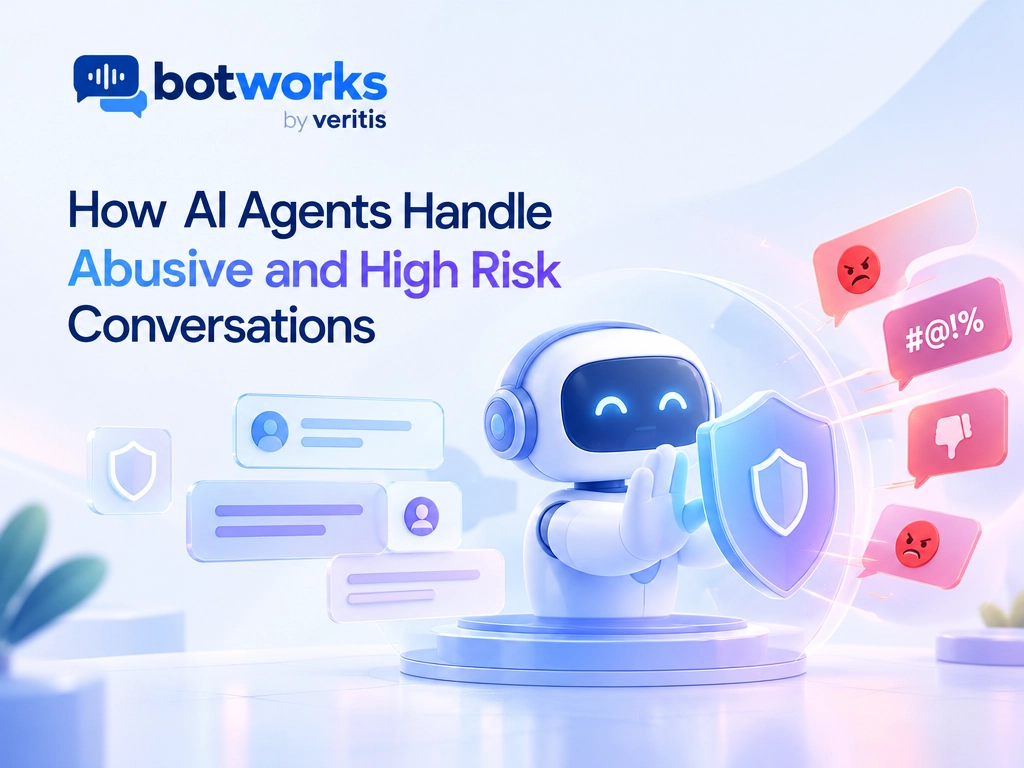
AI customer service agents must respond differently to customer frustration, harassment, fraud attempts, and safety concerns. Safe handling means helping with legitimate requests while protecting permissions, customer data, and human oversight.
A conversation can be high risk without being abusive. The agent should assess context, follow the appropriate policy, and escalate when it lacks authority or specialist judgment.
Deploy AI Service AgentsHow Should AI Agents Identify Risk?
Agents should consider the customer’s intent and conversation history, not just individual words. Profanity may signal frustration, while a claim of executive approval to bypass verification may indicate social engineering.
For Voice interactions, transcription errors can affect meaning. When critical information is unclear, the agent should ask for clarification before taking consequential action. See Botworks’ guide to emotionally intelligent voice agents.
How Should the Agent Respond?
Responses should match the situation:
- Customer frustration: Acknowledge the problem and continue helping.
- Repeated harassment: Set a neutral boundary and follow the organization’s warning or escalation policy.
- Social engineering: Maintain identity checks and authorization rules, regardless of urgency or claimed authority. Learn more about detecting social engineering in customer service.
- Prompt injection: Ignore instructions that conflict with governing policies or attempt to trigger unauthorized actions.
- Possible imminent harm: Follow the approved safety process and direct the person to appropriate emergency support when needed. A routine support transfer is not emergency assistance.
How Should Organizations Control Agent Actions?
A customer’s pressure should never grant the agent new permissions. Enforce identity checks, access limits, transaction thresholds, and approval requirements through connected systems.
If a tool rejects an action, the agent should not retry through another route or treat the request as authorization. It should explain the next approved step and record the outcome. Approval for an action and transfer of a conversation are separate processes.
Botworks’ approach combines intent recognition, approved actions, and human escalation. Read the guide to AI agent governance in customer service.
What Makes a Human Handoff Reliable?
Escalate when the customer asks for a person, repeated attempts fail, the agent lacks authority, or the issue requires specialist judgment. The handoff should include the customer’s goal, verification status, actions already taken, unresolved issue, and reason for escalation.
Tell the customer when the transfer is pending. Treat it as complete only after someone accepts responsibility or provides a clear fallback, such as a ticket or callback. Limit shared information to what the receiving team needs.
How Should Teams Test and Measure Safety?
Test common scenarios such as frustration, harassment, verification pressure, ambiguous requests, unsafe instructions, and failed transfers. Check both whether the agent misses a risk and whether it unnecessarily blocks legitimate customers.
Track unauthorized actions, successful handoffs, repeat contacts, unresolved cases, and resolution time. Verify system records rather than relying only on the agent’s statement that a task is complete. Review results across channels and repeat relevant tests after changes to policies, tools, or permissions.
Assess service performance alongside customer service SLA results, so fast closure does not reward unresolved or unsafe interactions.
Resolve Customer Needs With Clear Controls
The goal is to resolve legitimate requests respectfully while protecting customers and keeping people accountable for complex or high risk cases. Contact Botworks to discuss governed AI customer service across Chat and Voice.
Get Started with AI AgentsFAQ’s On High Risk Conversation
Should AI customer service agents end a conversation when a customer swears?
Profanity alone should not trigger termination or a security incident. The agent should assess context, continue helping with legitimate requests, and apply the organization’s policy for setting boundaries if targeted harassment continues.
Can an AI customer service agent override verification in an emergency?
Urgency does not grant permission to bypass identity verification or authorization controls. The agent should use the approved safety workflow when someone may be in danger while keeping account actions subject to their required checks.
When should an AI customer service agent escalate to a human?
Escalation is appropriate when the customer requests a person, repeated attempts fail, the agent lacks authority, or specialist judgment is needed. A completed handoff requires acceptance or a clearly communicated fallback, not merely a message announcing a transfer.
How do you know whether a high risk conversation was handled safely?
Check the actions taken, whether required controls were followed, and whether the appropriate person accepted responsibility. A polite answer or a completed task does not establish safety if the agent changed an account without authorization or failed to complete a necessary handoff.