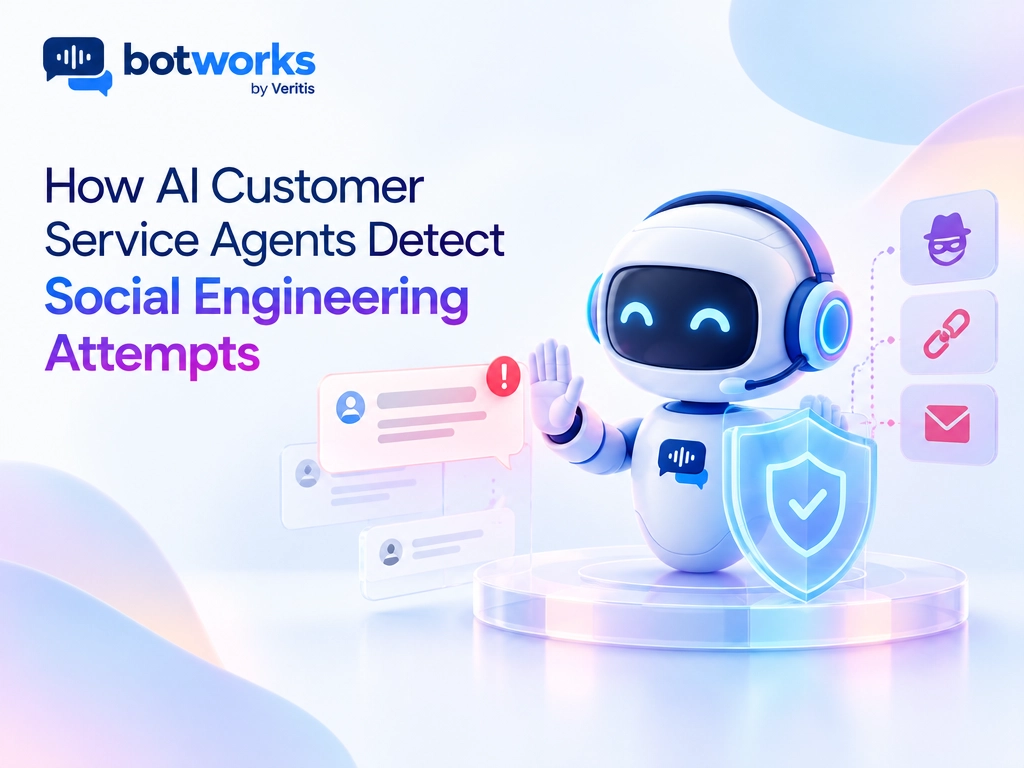
Social engineering uses trust, urgency, or impersonation to obtain information or trigger unauthorized actions. In customer service, an attacker might request a password reset, change recovery details, access another customer’s records, or claim a refund was already approved.
AI customer service agents can help identify suspicious requests, but conversation analysis alone cannot prove identity. Sensitive actions need independent verification and authorization controls.
What Should Customer Service Agents Watch For?
Warning signs include:
- Urgent requests to bypass normal verification
- Claims of executive or manager approval that cannot be confirmed
- Requests to change recovery details or payment destinations
- Attempts to access another customer’s information
- Instructions in messages or attachments that ask the agent to ignore its rules
A familiar name, account detail, or voice is not enough to establish identity. Risk signals should prompt verification, not automatically label a customer as fraudulent.
How Can AI Agents Detect Suspicious Requests?
Agents can compare the request with verified account information, recent activity, permissions, and approval records. A request to reset MFA, for example, needs stronger checks than a general product question.
They should also treat customer messages, attachments, and retrieved content as untrusted input. A document that claims “approval is complete” does not replace a valid approval record.
For AI Chat agents and Voice agents, use conversation signals to guide review while keeping authorization in the systems that execute the action.
How Should an Agent Respond?
1) Pause the Sensitive Action
Do not change account details, disclose protected records, or issue a refund while verification is unresolved.
2) Use an Approved Verification or Recovery Process
Do not replace it with personal questions or details supplied during the suspicious interaction.
3) Escalate with Context
Pass the requested action, verification results, relevant risk signals, and missing approvals to an authorized reviewer.
4) Record the Outcome
Keep an access controlled record of the decision and action. Avoid logging passwords, authentication codes, or unnecessary sensitive information.
5) Give the Customer a Clear Next Step
For example: “I can help with account recovery. This change requires additional verification. I can explain the approved alternatives.”
Human review should not become an easier route around the same security rules.
What Controls Should Protect Sensitive Actions?
The AI agent can interpret a request and propose an action. A separate policy layer should authorize it, and the connected system should enforce that decision.
| Workflow | Required control |
| MFA recovery | Approved recovery process and permission to reset the verified account |
| Refund request | Verified customer, eligible transaction, permitted amount, and required approval |
| Recovery detail change | Identity verification and authorization for the specific change |
| Protected record access | Verified identity and permission to access that record |
Apply the same authorization requirements across Chat, Voice, and employee tools. A customer switching channels should not bypass a failed verification or turn a previous conversation into proof of identity.
See Botworks’ guide to AI agent governance in customer service for more on permissions, approvals, and escalation.
How Can Teams Test and Measure Defenses?
Test impersonation, stolen sessions, voice cloning, reused approvals, malicious instructions in attachments, and repeated requests across channels. Include legitimate customers using new devices or recovering access to their accounts.
Track unauthorized actions prevented, false alarms, successful account recovery, escalation quality, and resolution time. A blocked request is not a good outcome if a legitimate customer has no practical way to get help.
Secure Customer Service Without Blocking Legitimate Requests
Effective protection combines identity checks, limited permissions, backend authorization, and human review. These safeguards help AI agents support customers while keeping sensitive actions within approved boundaries.
Explore the Botworks AI customer service platform for Chat and Voice, or contact Botworks to discuss your workflows.
FAQ’s on Customer Service Agents Detect Social Engineering Attempts
How do AI customer service agents help detect social engineering?
They can flag inconsistencies between a request, verified identity, account activity, permissions, and approval records. Independent controls must then decide whether the requested action can proceed.
Can a voice agent identify a deepfake?
Voice analysis may provide a risk signal, but voice familiarity cannot confirm identity. Account recovery should follow an approved verification process.
What is prompt injection?
Prompt injection places instructions in messages, attachments, or retrieved content to manipulate an AI agent. The agent should treat that material as untrusted and follow authorization rules enforced by connected systems.
When should an agent escalate a request?
Escalate when verification fails, approval is missing or disputed, or the request raises a security concern that requires an authorized reviewer.