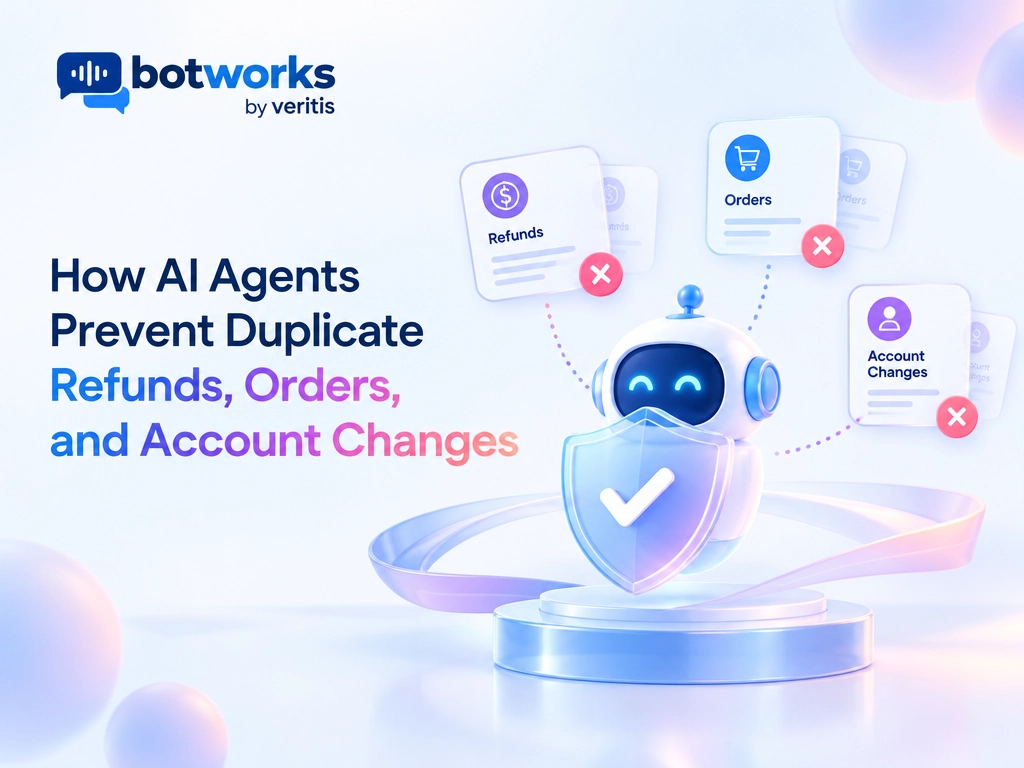
AI agents can help resolve customer requests, but retries, timeouts, and simultaneous activity across Chat, Voice, and employee tools can trigger the same action more than once. Preventing duplicate refunds or changes requires shared transaction records and backend controls, not conversational memory alone.
Deploy AI Refund AutomationWhy Do Duplicate Actions Happen?
A duplicate may occur when:
- A payment succeeds, but the response times out.
- An agent retries with a new operation ID.
- Two channels process the same request independently.
- Multiple workers check a transaction before either updates it.
- A webhook or workflow runs more than once.
A repeated request may also be a legitimate new action. For example, two partial refunds can be valid. Systems need to distinguish a retry of the same approved request from a new business request.
How Can AI Agents Prevent Duplicate Actions?
1) Give Each Business Request a Stable ID
Create a durable operation ID, such as a refund intent ID, before executing a financial action. Store it with the customer, payment, amount, currency, approval, and operation status.
Retries should reuse the same ID and request details. In Stripe API v1, an idempotency key helps return the saved result for a repeated request, but keys may be removed after at least 24 hours. Keep an internal operation record and reconcile unresolved requests before retrying them later.
2) Check Transaction State Atomically
Before execution, verify that the customer is authorized, the action is allowed, and the transaction is still eligible. For refunds, account for completed refunds and pending reservations.
The check and claim must happen as one atomic operation. Otherwise, two workers may both see an available balance and initiate a refund.
Use clear states such as awaiting_approval, executing, pending, succeeded, failed, and unknown. A timeout means the outcome is unknown, not necessarily that the operation failed.
3) Bind Approval to the Exact Action
Approval should apply to a specific customer, payment, amount, currency, and request. If any material detail changes, require new approval. Enforce approval in the system that executes the transaction, not only through an instruction to the AI agent.
4) Use Shared Records Across Channels
Chat, Voice, and employee tools should check the same operation record. A customer switching channels should not automatically create a new refund request. When intent is unclear, ask whether the customer is checking an existing request or asking for a separate action.
5) Reconcile Before Confirming Completion
Handle repeated or out-of-order webhooks safely. If a refund succeeds but a ticket update fails, retry the ticket update rather than submitting the refund again.
Tell the customer an action is complete only after verifying the result in the payment or business system.
What Safeguards Do Refunds, Orders, and Account Changes Need?
| Action | Stable operation ID | Additional safeguards |
| Refund | Refund intent ID | Check remaining balance, pending refunds, policy, and approval |
| Order creation | Checkout intent ID | Check for an existing order, inventory, pricing, and payment status |
| Account change | Change request ID | Verify account ownership, field permissions, and current record version |
Stripe allows multiple partial refunds until the original charge is fully refunded. Its remaining-balance check does not, by itself, identify whether two separate requests represent the same customer intent. The application must check business intent and transaction state as well.
How Should Teams Test Duplicate Prevention?
Test simultaneous requests, repeated approvals, changed request details, workflow restarts, duplicate webhooks, and timeouts after a payment provider accepts an action.
Track confirmed duplicate actions, unauthorized changes, false blocks, unresolved operations, approval effort, and resolution time. Measure these outcomes against a documented baseline.
For broader controls, see Botworks’ guide to AI agent governance in customer service and its overview of enterprise AI chat agents.
Prevent Duplicate Actions Across Customer Service
Reliable duplicate prevention combines a stable operation ID, atomic backend checks, transaction specific approval, and reconciliation. Apply these controls before expanding AI agents’ access to refunds, orders, or account changes.
Contact Botworks to discuss how governed actions can support customer service across Chat and Voice.
Prevent Costly Refund ErrorsFAQs on Duplicate Refunds
Is an idempotency key enough to prevent duplicate refunds?
No. It helps protect retries that reuse the same key. The application also needs a durable record of customer intent and checks for conflicting or concurrent transactions.
What should an AI agent do when a refund request times out?
Keep the operation in a pending or unknown state, check the provider’s transaction status, and reconcile before attempting another refund.
How can businesses prevent duplicates across Chat, Voice, and employee tools?
Connect all channels to shared operation records and the same transaction backend. Each channel should retrieve the existing request status before starting a new action.