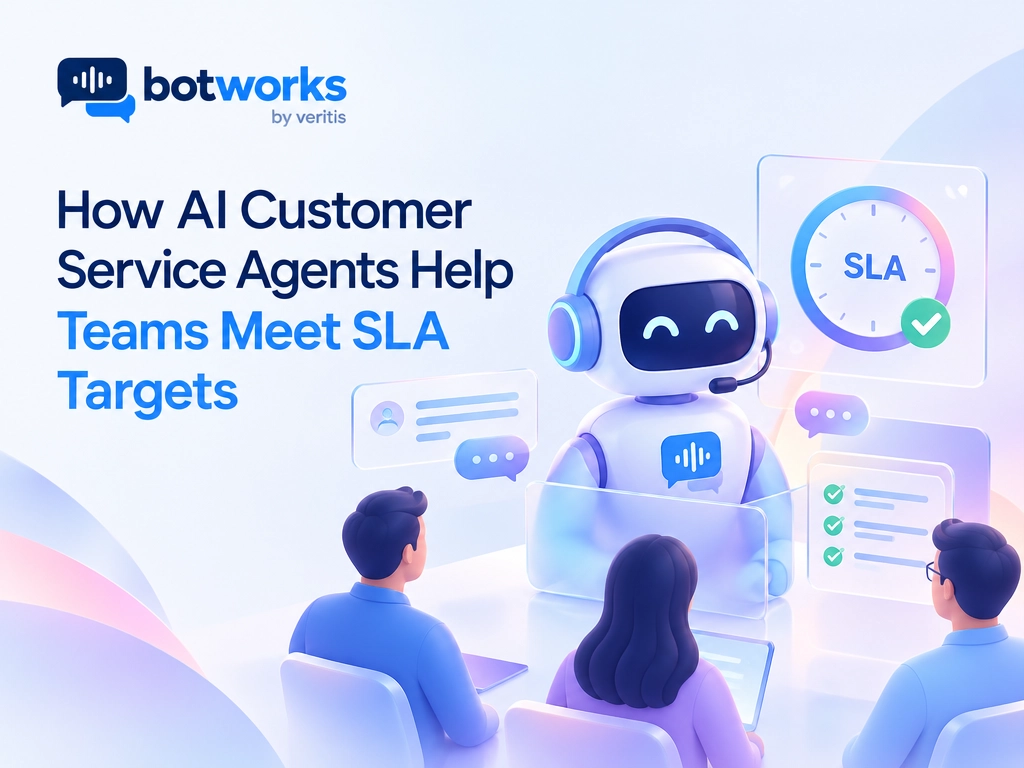
AI customer service agents can help teams meet service level agreement (SLA) targets by understanding requests, gathering information, completing authorized actions, and escalating unresolved cases in time. Their success depends on verified resolutions, not just fast acknowledgments.
What Can AI Agents Improve?
A chatbot may answer a policy question, while an agent can follow a bounded workflow. For example, it can verify a customer, check whether an order is eligible for cancellation, submit the request, and confirm the result.
Use AI agents for requests with clear rules, reliable data, and measurable outcomes. Keep sensitive disputes and decisions requiring human judgment with employees. See the Botworks AI customer service platform for how AI can support customer workflows.
Explore AI Agent SolutionsHow Should You Map SLAs to a Workflow?
Define how your team measures:
- Response time: When the customer receives a useful reply.
- Resolution time: When the request is completed and verified.
- Escalation time: How much time remains for a human to resolve the case.
Set priority rules, completion criteria, and escalation ownership before automating a workflow. An automated acknowledgment alone may not count as meaningful help or satisfy an SLA.
How Do You Design a Reliable AI Workflow?
Start with one frequent, well-defined request. A safe workflow should:
1) Identify the customer’s intent and verify their identity.
2) Check eligibility and collect any missing details.
3) Take only actions permitted by policy and system permissions.
4) Confirm the result using the connected system.
5) Escalate uncertain, sensitive, or failed requests with the conversation context and remaining SLA time.
If a system is unavailable or a transaction result is uncertain, the agent should say so and follow the defined escalation path. It should never claim an action is complete without confirmation.
For more on permissions, oversight, and escalation, read the Botworks guide to AI agent governance in customer service.
How Should You Measure Results?
Compare the pilot with a baseline for similar request types and channels. Track:
- Response and resolution SLA attainment separately
- Verified resolutions, repeat contacts, and reopened cases
- Incorrect or incomplete actions
- Customer satisfaction and handoff quality
- Total cost per verified resolution
Review failures before expanding automation. Include integration, monitoring, human review, and repeat contacts when assessing cost. Reduced manual work does not automatically mean financial savings; measure how the released capacity is used.
Which Customer Service Use Cases Should You Automate First?
Prioritize requests with sufficient volume, clear eligibility rules, reliable integrations, and observable completion. The following are illustrative workflows, not promises that every platform supports every action.
| Request | Potential approved action | Evidence of completion | Escalation trigger |
| Order cancellation | Cancel an eligible order | Order system confirms cancellation | Fulfillment has advanced beyond eligibility |
| Appointment change | Reschedule within permitted availability | Scheduling system confirms the new appointment | No acceptable appointment is available |
| Billing inquiry | Retrieve and explain an authorized invoice | Customer receives verified invoice details | Customer disputes the charge |
| Account update | Change permitted contact details after verification | Account system confirms the update | Identity verification fails |
AI Chat agents can support written exchanges and collection of structured details. AI Voice agents can support spoken requests, but require careful handling of interruptions, recognition errors, and confirmation of critical information. Apply the same authorization and completion standards across both channels.
Which Requests Are Good Candidates?
Consider workflows such as eligible order cancellations, appointment changes, billing inquiries, and account updates. Automate them only when the rules are clear, the required systems are available, and successful completion can be verified.
Conclusion
Botworks Chat and Voice agents can support these workflows across channels. Apply the same authorization, confirmation, and escalation standards to both.
Start with one measurable workflow, confirm that it works safely, and expand based on results. Contact Botworks to discuss your customer service requirements.
Deploy AI Service AgentsFAQ’s on AI Customer Service Agents
What are AI customer service agents?
AI customer service agents are systems that manage bounded service workflows, use connected tools, and take authorized actions. Unlike a chatbot that only explains a policy, an agent can apply that policy to a customer request and verify the resulting action.
How do AI customer service agents help meet SLA targets?
AI customer service agents can reduce queue time by identifying intent, collecting details, and completing eligible requests without repeated human handoffs. They also support escalation based on SLA deadlines by transferring unresolved cases with context and enough remaining time for a representative to act.
Does an automated acknowledgment count as an SLA response?
An automated acknowledgment is not the same as meaningful help or a human response. Whether it satisfies a particular SLA depends on the agreement and the helpdesk rules used to measure that commitment.
When should an AI customer service agent escalate to a human?
An agent should escalate when the customer requests a person, the answer is uncertain, a transaction fails, or the request involves a sensitive dispute or an action outside policy. Escalation should happen before the remaining SLA time becomes insufficient for human intervention.
How do you measure whether an AI customer service agent is effective?
Measure verified completion, response and resolution SLA attainment, repeat contacts, reopened cases, incorrect actions, and customer satisfaction against a comparable baseline. Evaluate total service cost per verified resolution rather than cost per automated conversation alone.