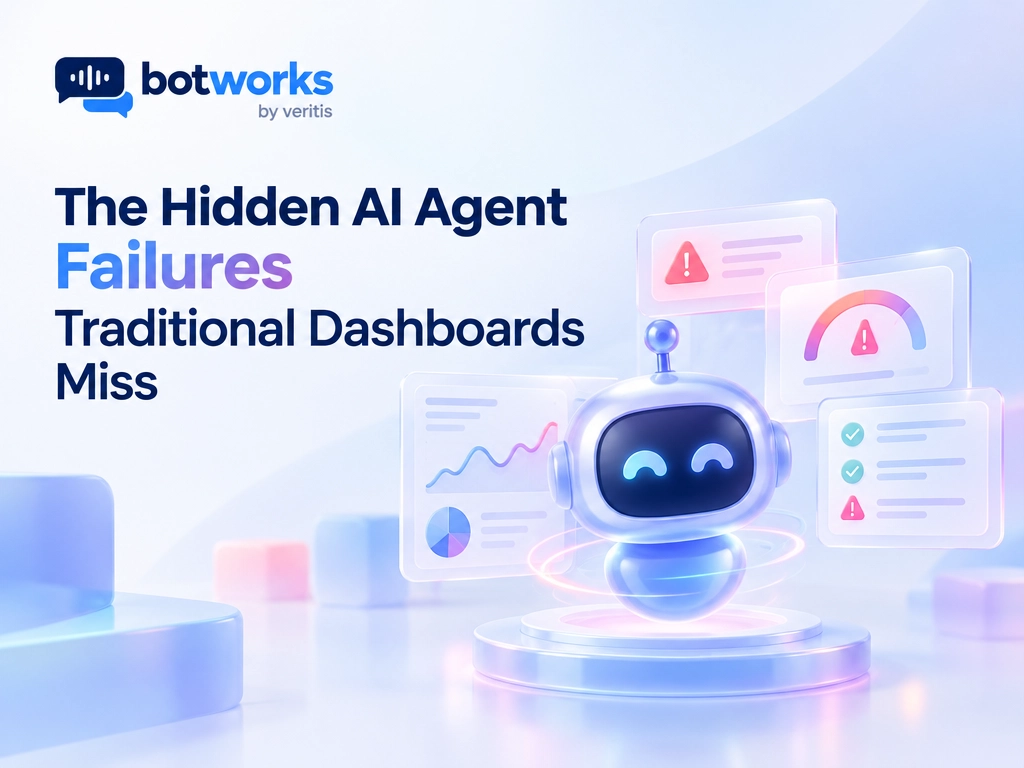
Hidden AI agent failures occur when an interaction appears technically successful but fails the customer’s objective, required action, or governing policy. Detecting them requires checking actual outcomes, permissions, and system records, not just uptime, response speed, or completion messages.
Your dashboard shows healthy uptime and fast responses. A customer hears that their refund is complete, but no refund exists. The interaction looks successful while the service outcome has failed.
Hidden AI agent failures emerge between technical execution and actual resolution. This guide explains what conventional monitoring misses, which signals reveal problems, and how to build measurable controls across Chat and Voice.
Optimize AI Agent OperationsWhat Are Hidden AI Agent Failures?
1) What Makes An AI Agent Failure Silent?
A silent AI agent failure occurs when an interaction appears successful but misses the customer’s objective, required action, or governing policy.
According to Anthropic’s guide to agent evaluations, evaluating agents requires examining outcomes and execution, not simply accepting a convincing final response.
2) Which Failure Patterns Should Teams Recognize?
Five patterns deserve attention:
- Apparently Correct But Incomplete Responses: An answer explains eligibility but omits a required deadline.
- Completion Without Resolution: An agent closes a request before the promised change reaches the system of record.
- Incorrect Actions With Successful Status Codes: An API accepts an update to the wrong customer account.
- Policy Violations in Normal Conversations: A helpful sounding response exposes restricted information or bypasses approval.
- Unreported Failures: Customers leave without complaining, so feedback alone cannot establish success.
The central distinction is simple: successful execution is not necessarily correct behavior.
Why Do Traditional Dashboards Miss AI Agent Failures?
Traditional dashboards remain valuable for infrastructure health. Their blind spots arise when operational metrics become proxies for resolution.
What Do Infrastructure Metrics Leave Out?
- Overreliance on Uptime: Availability proves the service responded, not that it understood the request.
- Limited Conversation Visibility: Latency and error counts cannot establish whether an answer was relevant, complete, or grounded.
- Success Without Validation: A closed ticket or agent completion message can inflate apparent success.
- Missing Connected Context: Conversation logs, payment records, CRM updates, and escalation queues may tell different stories.
- Misleading Aggregates: Strong average performance can conceal failures concentrated in one workflow or customer group.
Keep operational dashboards, but connect them to independently verified business outcomes.
What Silent Failures Occur in Customer Service?
1) What Do Hidden AI Agent Failures Look Like in Practice?
These illustrative scenarios show how failures develop:
- Misinterpreted Intent: “Stop my next delivery” becomes permanent account cancellation instead of a temporary pause.
- Incorrect Knowledge Retrieval: The agent retrieves an expired refund policy and gives a confident but outdated answer.
- Incomplete Workflow Execution: It updates a shipping address but never changes the pending shipment.
- Failed Human Escalation: It promises a specialist callback without creating an assigned case.
- Unauthorized or Inappropriate Actions: It issues a refund without required approval or modifies another customer’s record.
2) Why Should Retrieval And Generation Be Checked Separately?
Retrieval and generation need separate checks. An answer can accurately repeat a source that is itself outdated or incomplete.
3) What Additional Failures Should Voice Teams Test?
For AI Voice Agents, test transcription errors in names, amounts, and account identifiers. Verify that interruptions, silence, and call transfers preserve intent and context. A connected call does not prove that the receiving team accepted the case.
Which Signals Reveal Hidden AI Agent Problems?
1) Which Behaviors Warrant Investigation?
Monitor behavior that suggests unresolved work:
- Repeated Questions: Customers restate their objective after receiving an answer.
- Unexpected Abandonment: Conversations end after confusion, an unanswered question, or a failed action.
- Frequent Corrections: Customers or employees repeatedly repair answers and account changes.
- Unusual Workflow Patterns: Tools repeat identical calls, actions occur out of order, or tasks produce duplicate records.
- Rising Human Intervention: More interactions require manual recovery or reversal.
2) How Should Teams Interpret Warning Signals?
These are investigation signals, not automatic failure verdicts. Abandonment may follow a satisfactory answer, and intervention may reflect appropriate escalation. Compare patterns within similar tasks and risk levels.
How Do You Measure Performance Beyond Dashboards?
1) How Do You Define Success Before Measuring It?
Define a task contract before selecting metrics: the customer objective, required evidence, allowed actions, and conditions that must remain true.
For a refund, specify the authorized account, approved amount, required approval, payment record, and verification window. Distinguish “submitted” from “settled” so processing delays do not become false completion claims.
2) Which Measures Establish Whether An Agent Succeeded?
Use five complementary measures:
A) Intent Recognition Accuracy: Correctly identified intents divided by reviewed interactions, using human reviewed labels.
B) Verified Resolution Rate: Tasks with independently confirmed outcomes divided by eligible tasks. Report unverified outcomes separately.
C) Task Completion Quality: Check required steps, correct records and amounts, and absence of unintended changes. A partial workflow is not full completion.
D) Escalation Accuracy: Measure both required escalations that occurred and appropriate escalations. Verify routing, context transfer, and acceptance.
E) Policy Compliance Rate: Compliant actions divided by evaluated eligible actions. Report severe violations separately so averages cannot conceal them.
3) How Should Performance Results Be Segmented?
Also track false completion, reopened cases, reversals, and cost per verified resolution. Segment results by task, channel, risk, and model or workflow version.
How Do You Build Better AI Agent Observability?
OpenTelemetry’s GenAI conventions provide a foundation for instrumentation. Add business outcome and policy events to make traces operationally useful.
1) How Do You Connect The Conversation to Its Consequences?
Assign a shared identifier across the conversation, tool calls, workflow steps, and human handoffs. Preserve the original customer goal so reviewers can detect task drift across otherwise reasonable steps.
2) How Should You Monitor Tools, Knowledge, and Actions?
Record tool inputs, results, retries, and persisted changes. Inspect response content, not just HTTP status. Capture knowledge source identifiers and versions, then check whether retrieved evidence supports the answer.
Log observable decisions, applicable permissions, approvals, and action results. Independent system records should corroborate agent claims.
3) How Do You Alert On Actionable Failures?
Trigger immediate review for unauthorized actions, approval bypasses, and completion claims contradicted by system state. Route repeated loops and missing handoff acknowledgments to an accountable owner.
NIST’s Generative AI Profile supports risk focused monitoring and protection of sensitive telemetry. Apply access controls, redaction, and retention limits to conversation and action logs.
Make missing traces and failed outcome checks visible within enterprise AI agent operations. Missing evidence means an outcome is unverified, not successful.
How Can You Prevent Silent Failures Before Customers Encounter Them?
1) What Testing and Controls Should Teams Put in Place?
Use an ordered testing and control process:
A) Test Before Deployment
Replay representative conversations in a sandbox. Define expected outcomes and prohibited actions, not one mandatory wording or path.
B) Create Synthetic Customer Scenarios
Include ambiguous requests, missing evidence, stale policies, interrupted workflows, and malicious instructions embedded in retrieved content.
C) Validate Permissions And Policy
Test revoked access, approval requirements, and attempts to act on the wrong account. Enforce authorization outside the model.
D) Evaluate Continuously
Combine deterministic state checks, model based assessments, and human audits. Calibrate evaluators against human judgments.
E) Automate Escalation Rules
Route unresolved loops, conflicting records, sensitive exceptions, and failed verification to qualified people with context attached.
2) How Do Audits Feed Ongoing Regression Testing?
Maintain a random audit sample alongside targeted reviews of risky sessions. Do not treat the targeted sample as representative of overall failure rates. Convert confirmed failures into regression tests and repeat trials to assess consistency.
3) What Should Happen After a Confirmed Failure?
Pause the affected action when risk warrants it. Assign an owner, verify the system state before retrying, and repair the customer outcome. Record the cause and corrective control within your AI governance process.
How Does BotWorks Support Reliable AI Customer Service?
BotWorks positions its enterprise AI customer service platform around understanding the customer, taking approved action, resolving the issue, and measuring the outcome.
Which Capabilities Support Reliable Service Outcomes?
Its reliability approach includes:
- Approved enterprise knowledge to support answers within defined information boundaries.
- Governed service actions within business and compliance rules.
- Conversation visibility into customer interactions and performance.
- Intelligent human escalation when judgment or intervention is required.
- Continuous performance improvement focused on measurable service outcomes.
Explore the BotWorks platform when assessing how Chat and Voice automation should connect enterprise workflows with operational control.
Conclusion
A healthy system is not proof of a resolved customer need. Measure what changed, whether it was authorized, and whether it satisfied the original request.
Book a consultation with Botworks to assess your current environment and define a clear path toward reliable, governed AI customer service.
Prevent AI Agent FailuresFrequently Asked Questions on AI Agent Failure
What Is A Silent AI Agent Failure?
An apparently successful interaction that fails its objective, required action, or policy constraints without an obvious technical error.
Why Do Traditional Dashboards Miss AI Failures?
They measure system execution more readily than intent, authorization, conversation quality, and verified resolution.
How Can Silent Failures Affect Customer Experience?
They can leave requests unresolved, create repeat contacts, introduce incorrect account changes, and undermine trust.
Which Metrics Reveal Hidden AI Agent Problems?
Prioritize verified resolution, false completion, intent accuracy, task quality, escalation accuracy, and policy compliance.
How Can Enterprises Prevent Silent Failures?
Combine realistic testing, enforceable permissions, connected traces, independent outcome checks, continuous evaluation, and reliable human escalation.