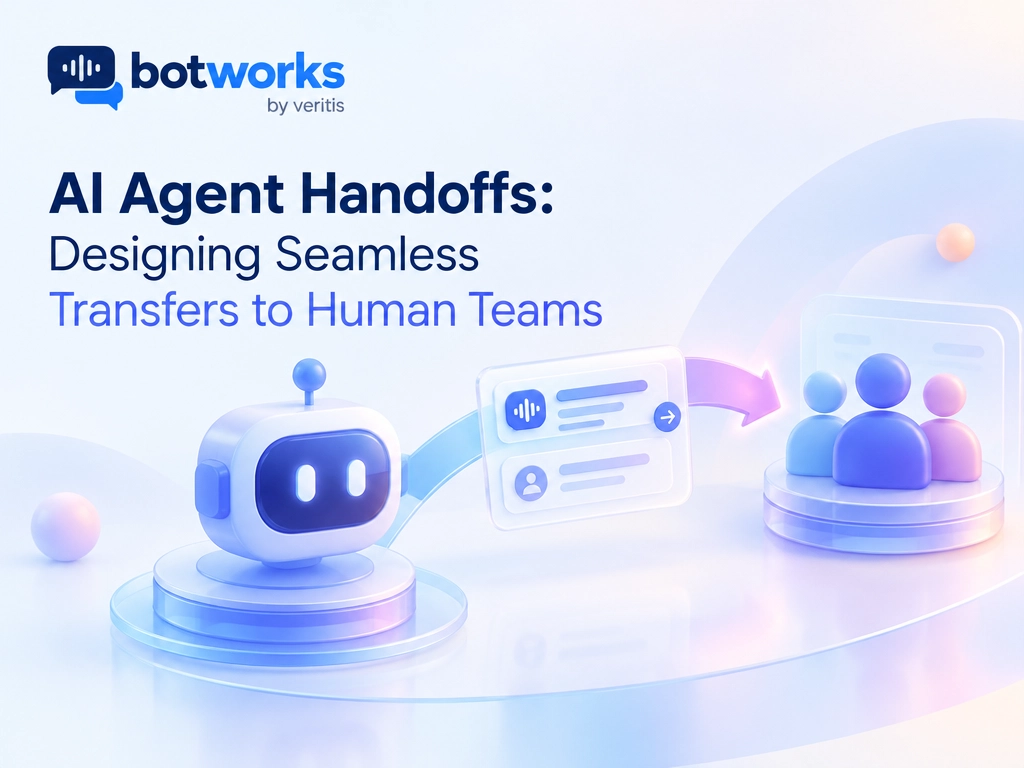
AI agent handoffs transfer a decision or responsibility from an AI agent to a human while preserving context, execution state, and clear ownership. A seamless handoff specifies what pauses, who can act next, and what must be verified before automation resumes.
A customer explains a billing problem to an AI agent, then repeats everything when a specialist joins. Meanwhile, an automated refund remains pending. The conversation transferred, but responsibility did not.
Seamless handoffs between AI agents and human teams require a clear contract: what transfers, who can act, and when automation may continue. This guide covers the operational rules, technical architecture, and performance measures needed across Chat and Voice.
Improve AI Agent HandoffsWhat Are AI Agent Handoffs?
An AI agent handoff is a controlled transition in a workflow: a human may approve an action, supply expertise, edit a proposal, or take ownership of a case. It doesn’t always require the AI to stop all work, but it does require clear boundaries for what the AI and human can do.
The distinction is operational: transferring a conversation gives someone access to the discussion; transferring responsibility establishes who owns the next decision and which actions they are authorized to take.
How Do You Define the Kind of Handoff?
Not every escalation requires a complete takeover. Define four interaction types:
- Approval: A person approves or rejects a specific action. Execution pauses before that action.
- Consultation: A specialist supplies missing information. Independent, permitted work may continue.
- Collaborative editing: A reviewer corrects a proposed response or action. Changes require validation.
- Ownership transfer: A human assumes responsibility for the case. The AI stops conflicting actions and becomes an assistant or observer.
For each type, specify the next owner, blocked actions, permitted edits, and completion conditions. A notification is not acceptance of responsibility.
How Do You Set Escalation Rules Before Launch?
Use three layers of triggers:
- Mandatory boundaries: Missing authorization, restricted actions, policy exceptions, or required approvals.
- Operational limits: Repeated tool failures, stalled progress, or expired deadlines.
- Judgment signals: Ambiguous intent, conflicting evidence, distress, or an explicit request for a person.
Enforce mandatory boundaries through workflow rules and tool permissions, not model discretion. Confidence alone should never authorize a consequential action.
How Should An Escalated Case Reach the Right Person?
Route cases by expertise, permissions, urgency, and capacity. Assign a response deadline, backup queue, and safe outcome if nobody accepts. Limit repeated transfers so customers do not circulate indefinitely.
Use the AI customer service readiness guide to assess these controls before deployment.
How Do You Transfer a Decision Brief and Execution State?
Give the human a concise brief containing:
- Customer intent, verified identity status, and relevant account details.
- Escalation reason and the exact decision requested.
- Completed actions, confirmed outcomes, and pending operations.
- Evidence, uncertainties, applicable policy, and deadline.
Keep authoritative records available behind the summary. Separate verified facts from AI interpretations, and expose only information the recipient is authorized to access.
What Execution State Must the System Preserve?
In parallel, preserve a machine record containing the case identifier, workflow checkpoint, state version, action identifiers, owner, and resume conditions. A transcript cannot replace execution state.
According to Vasconcelos and colleagues’ research, explanations reduced overreliance when they made recommendations easier to verify. Design the brief for checking evidence, not persuading reviewers to agree.
How Do You Protect Sensitive Data During A Handoff?
Apply role based access to summaries, transcripts, recordings, and attachments. Minimize transferred personal data, redact restricted fields, and enforce retention policies. Treat customer messages as evidence, not instructions that can override authorization rules. Audit access as well as approvals and actions.
How Do You Make Ownership Durable?
Represent progress explicitly: AI active, handoff pending, human owned, resume pending, then completed, canceled, or safely stopped.
Use version checks so two reviewers cannot claim the same task simultaneously. Ownership changes must revoke the previous actor’s authority over conflicting actions.
Which Architecture Supports Reliable AI Agent Handoffs?
Architecture choices depend on workflow complexity:
- Checkpointed agent graphs: Useful for agent workflows with review and editing.
- Durable workflow engines: Suitable for processes spanning systems, retries, and long waits.
- Database task state machines: Viable for smaller implementations, provided the team builds recovery, timers, and concurrency controls.
Connect orchestration to a human task queue, agent desktop, policy gateway, and shared audit records. Observability tools detect problems but do not establish ownership.
The AWS transactional outbox guidance addresses keeping task updates and notifications consistent. Receivers must still tolerate duplicate delivery.
How Do You Preserve Continuity Across Chat and Voice?
1) What should customers hear during a handoff?
Tell customers why specialist help is needed, what context will transfer, and what happens next. Do not promise an immediate connection unless capacity supports it.
2) How do Chat and Voice handoffs differ?
In Chat, preserve conversation continuity and offer an asynchronous update when necessary. In Voice, transfer the briefing alongside the call. If nobody is available, provide a callback or case reference rather than an unexplained disconnect.
3) What does a controlled handoff look like in practice?
For example, an appointment agent can gather preferred times, then escalate a policy exception without booking an unauthorized slot. The specialist receives the request, available options, and pending action. Our appointment changes guide explores this service workflow.
How Do You Resume Through an Authorization Check?
Before automation restarts:
1) Authenticate the responder and verify authority.
2) Match the decision to the exact action and proposal version.
3) Reject expired, duplicate, canceled, or stale decisions.
4) Record human changes and reconcile current business data.
5) Recheck permissions and action prerequisites.
6) Resume, replan, request fresh approval, or close.
7) Verify the external outcome and inform the customer.
How Do You Prevent Duplicate Actions After a Handoff?
If a refund request times out, check whether it succeeded before retrying. Use stable operation identifiers and idempotency controls where supported. Maintain an audit trail of who approved what and when.
How Do You Test and Measure the Whole Transfer?
1) Which handoff failures should you test?
Test worker crashes, duplicate alerts, simultaneous claims, unavailable reviewers, changed permissions, and tool success with a lost response.
2) Which metrics show whether a handoff works?
Measure acknowledgment time separately from time to the first correct action. Track resolution time, repeat explanations, unowned cases, successful resumptions, duplicate actions, and repeated escalations. Evaluate decision quality against human only and AI only baselines, not satisfaction alone.
Define successful resumption as automation restarting with valid authorization and a verified outcome. Calculate repeat explanation rate as handoffs requiring customers to restate information divided by reviewed handoffs. Use consistent definitions alongside AI agent resolution quality metrics.
3) How should you roll out handoff workflows?
Start with one bounded workflow and named operational owners. Review simulated transfers before a limited production release. Expand only after ownership, authorization, recovery, and customer communication meet predefined acceptance criteria. Keep a safe stop available throughout deployment.
Book a consultation with Botworks to assess your current environment and define a clear path forward.
Conclusion
BotWorks’ enterprise AI customer service approach centers on understanding intent, taking approved actions, and escalating when human judgment is required. Effective handoffs extend that principle: preserve context, establish ownership, verify outcomes, and measure service performance.
Book a consultation with Botworks to assess your current environment and define a clear path forward.
Get Started with AI Agents