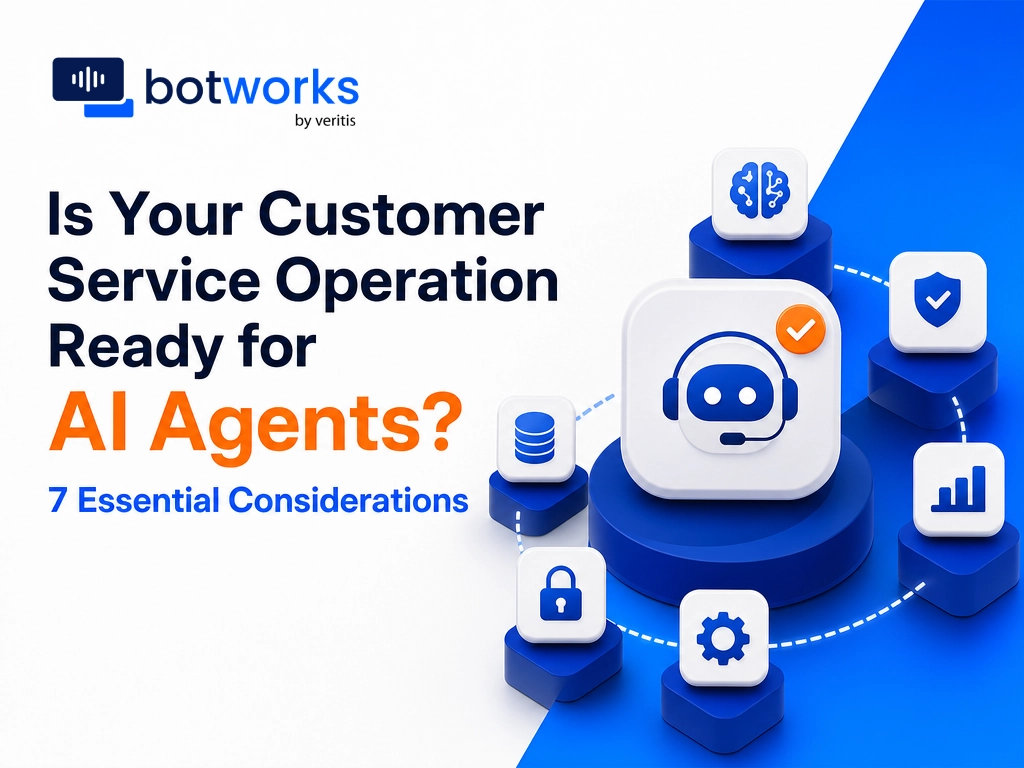
AI agents customer service readiness means your strategy, data, governance, capacity, ethics, integration, and measurement are prepared to deploy AI agents safely and at scale. It is the difference between running a pilot and running a reliable operation.
AI agents are reshaping customer service. They resolve routine requests, cut wait times, and free your team for complex work. But readiness, not enthusiasm, decides whether a pilot becomes real business value. This guide walks through seven considerations that separate teams that scale from teams that stall.
The stakes are clear. Recent enterprise AI research shows that 83% of organizations now operate AI agents in some capacity. Yet only 36% have connected those agents to trusted internal data, and just 14% have scaled a pilot to organization wide production. Most teams are running experiments. Few are running an operation.
What Are AI Agents for Customer Service?
AI agents for customer service are advanced digital systems that automate routine tasks, resolve customer queries, and deliver personalized support across chat, voice, email, and social channels.
The best enterprise agents do more than answer questions. They understand intent, follow business rules, connect to your systems, take approved actions, and escalate when human judgment is required.
- Autonomous AI: Operates with minimal human oversight to deliver seamless interactions.
- Conversational AI: Uses natural language processing to hold humanlike dialogue.
- Workflow execution: Completes multi step tasks, not just replies.
How Do AI Agents Work?
AI agents combine machine learning and natural language processing to understand a request and act on it. They follow defined actions and improve with every interaction.
- Understanding queries: The agent reads intent and sentiment.
- Action execution: It runs the right task based on that intent.
- Learning and adaptation: It refines performance over time.
The principle is simple. Understand the customer. Take the right action. Resolve the issue. Measure the outcome.
7 Key Considerations Before You Scale: Why Readiness Matters More Than the Model
Buying capable AI is easy. Deploying it responsibly at scale is hard. Research on enterprise scaling failures points to five recurring bottlenecks: legacy system integration complexity, inconsistent output quality at volume, absent monitoring tooling, unclear organizational ownership, and thin domain training data. Together, these account for roughly 89% of failed scale efforts.
The seven considerations below map directly to those risks. Treat them as a readiness checklist before you commit budget.
1) Strategy and Culture
Start with the outcome, not the technology. Decide which customer problems you want AI to resolve first. Refund status, order tracking, and password resets are common early wins.
Culture matters as much as strategy. Your agents will not adopt AI if they fear it. Position AI as support that removes repetitive work so people can handle conversations that need empathy and judgment.
Key takeaway: A named business goal and a supportive team beat a bigger model every time.
2) Data and Technology Infrastructure
AI is only as good as the data it can reach. This is the gap most teams underestimate. Even among organizations already running agents, only about a third have linked them to trusted internal company data.
Ask three questions before you scale:
- Is your knowledge base current, accurate, and structured?
- Can the agent read from your CRM, order system, and help desk in real time?
- Do you have clean domain data to train and test on?
Without trusted data, an agent guesses. With it, an agent resolves. Weak data foundations are a leading reason pilots never reach production.
Key takeaway: Connect agents to trusted, current data or expect confident wrong answers.
3) Governance and Security
Enterprise AI must operate inside clear rules. Governance defines what an agent may do, what it may access, and when it must hand off to a person.
Prioritize these controls:
- Role based access to sensitive customer data.
- Approved actions only, with audit trails for every task.
- Compliance with regulations such as GDPR and relevant industry standards.
- Clear escalation paths for high risk requests.
Security is not a feature you add later. It is the condition that makes automated action safe. Learn how customer identity verification strengthens this foundation in high stakes interactions.
Key takeaway: Define approved actions and audit trails before an agent touches real accounts.
4) Resources and Capacity
AI agents reduce manual workload, but they do not run themselves. Someone must own them.
Plan for the people behind the platform:
- A clear owner for agent performance and quality.
- Analysts who monitor outputs and catch drift.
- Trainers who keep knowledge and workflows current.
Absent monitoring tooling and unclear ownership are two of the five bottlenecks that block scale. Assign both from day one.
Key takeaway: Give AI agents an owner, a monitor, and a maintenance routine.
5) Ethics and Risk
Automated service carries real responsibility. A misfiring agent can frustrate customers or expose the business.
Set guardrails for the hard cases:
- Transparency: Tell customers when they are speaking with AI.
- Bias checks: Test responses across customer groups and scenarios.
- Fallback: Escalate quickly when the agent is uncertain.
- Accountability: Keep a human owner for outcomes, not just tasks.
Intelligent escalation is the difference between confident automation and reckless automation. Route the moment judgment is required.
Key takeaway: Automate the routine, escalate the sensitive, and always be honest about who is responding.
6) Integration and Workflows
Value appears when an agent completes work, not just chats. That requires deep integration with the systems your team already uses.
Map the workflows you want to automate end to end:
- Look up an order and issue a refund inside policy.
- Update a shipping address across connected systems.
- Create, update, or close a ticket in your help desk.
Legacy integration complexity is the number one scaling bottleneck in the research above. Solve it early, and the rest gets easier. You can review real deployment patterns in these Posts.
Key takeaway: An agent that acts inside your systems delivers value a basic chatbot never will.
7) Measurement and ROI
Readiness ends with proof. Decide how you will measure success before launch, then track it consistently.
Customer service is the fastest path to measurable return. Industry findings show 74% of executives achieved ROI within the first year, with documented returns averaging 171% and reaching 192% among US enterprises. Service teams report saving more than 40 hours per agent each month. Klarna’s widely cited deployment reported around $60 million in savings and a 25% reduction in repeat inquiries within a single quarter.
Track a focused set of metrics:
- Resolution rate without human help.
- Average handle and wait time.
- Cost per ticket.
- Customer satisfaction after AI interactions.
For a deeper look at the business case, explore AI agents value, ROI, and real examples from enterprise deployments.
Key takeaway: Define your metrics first, then let the numbers justify the next stage of rollout.
How AI Agents Improve Customer Experience
When these seven pieces are in place, the customer experience improves in visible ways.
- Speed and availability: Faster responses and 24/7 service across every channel.
- Cost efficiency: Lower per ticket costs as routine work is automated.
- Scalability: Many conversations handled simultaneously, without adding headcount.
- Data driven insight: Real time understanding of what customers ask and why.
These insights feed back into strategy. They sharpen knowledge management, staffing, and product decisions. See how chat and voice AI deliver unified customer experiences across both channels.
Request Your AI Readiness Check
A short readiness check turns guesswork into a plan. It scores where you stand across strategy, data, governance, capacity, ethics, integration, and measurement.
Who is this for? Enterprise IT leaders, CIOs, CTOs, CFOs, and customer service and CX leaders driving AI transformation across the business.
Flexible offerings to match your needs. Whether you are exploring a first pilot or scaling to production, an assessment can meet your team where it is.
Expert guidance every step of your AI journey. The goal is not a report on a shelf. It is a clear next action for each of the seven considerations.
Take Our AI Readiness Assessment
Tailored for leaders driving AI transformation, an assessment gives you a practical view of gaps and priorities. Investment in customer service AI is rising, with 64% of CX leaders increasing spend, so the question is no longer whether to adopt but how to adopt with control.
Use your results to sequence the work. Fix data and integration first. Layer governance and ethics as guardrails. Then measure, prove, and scale.
Key Takeaways
- Readiness beats hype. Most teams run AI agents; few have scaled them.
- Data is the constraint. Connect agents to trusted internal data before scaling.
- Governance enables action. Approved actions and audit trails make automation safe.
- Escalation is a feature. Route to humans when judgment is required.
- Measure to justify. Customer service delivers the fastest, clearest ROI.
Conclusion
AI agent success depends on more than technology. It requires trusted data, clear governance, secure integrations, measurable outcomes, and the right path to human support.
Botworks brings these elements together through enterprise AI agents designed to understand customer intent, act within defined rules, and move conversations toward resolution with greater speed, control, and consistency.
Explore AI Agents for Customer ServiceFAQs: AI agents in Customer Service Readiness
What does AI agents customer service readiness mean?
Readiness means your strategy, data, governance, capacity, ethics, integration, and measurement are prepared to deploy AI agents safely and at scale. It is the gap between running a pilot and running a reliable operation.
How do I know if my organization is ready for AI agents?
Assess the seven considerations in this guide. If your knowledge base is current, your agents can reach trusted data, and you have clear ownership and escalation rules, you are close to ready.
Why do most AI agent pilots fail to scale?
Research points to five bottlenecks: legacy integration complexity, inconsistent output quality, missing monitoring tools, unclear ownership, and thin domain data. Together, they account for roughly 89% of scaling failures.
What is the ROI of AI agents in customer service?
Customer service is the fastest path to return. Industry findings report average returns of 171%, with 74% of executives achieving ROI within the first year and service teams saving more than 40 hours per agent each month.
How do AI agents keep customer data secure?
Enterprise agents work inside defined rules with role based access, approved actions, full audit trails, and compliance controls. They escalate high risk requests to a human owner rather than acting alone.