Customer service efficiency is the swift, precise resolution of customer inquiries using the fewest resources possible. It helps modern enterprises meet rising customer expectations while controlling costs. This guide explains what efficiency means, why it matters, and how to improve resolution across every channel.
What is Customer Service Efficiency?
Customer service efficiency is the ability to resolve customer issues quickly and correctly while using minimal time, effort, and cost.
It combines three things:
- Streamlined processes that remove friction and delay.
- Strategic technology that automates routine work.
- Skilled agents who handle complex, high judgment cases.
The goal is not speed for its own sake. The goal is real resolution. A fast reply that fails to solve the problem is not efficient. True efficiency closes the issue on the first attempt whenever possible.
Improve Customer Service EfficiencyWhat Efficient Customer Service Looks Like
- Customers reach the right answer with little effort.
- Routine questions resolve instantly through automation.
- Complex issues route to the best qualified agent.
- Every interaction is consistent across chat, voice, and email.
- Leaders can measure resolution, cost, and satisfaction in real time.
Why is Efficiency Important in Customer Service?
Efficient customer service raises satisfaction, lowers cost, and strengthens brand reputation. It directly affects revenue, retention, and operational control.
1) Customers Expect Speed
Customers now expect near instant help. Industry surveys suggest that around three in four customers expect help within 5 minutes of reaching out. Slow response is one of the fastest ways to lose a customer to a competitor.
2) Efficiency Drives Customer Satisfaction
Efficient service meets customer expectations for quick and accurate support. That builds loyalty and repeat business.
- Rapid response: Customers get help in minutes, not hours.
- Accurate resolution: Tailored answers solve the exact issue.
- Minimal effort: Lower customer effort reduces frustration and builds trust.
3) The Financial Advantage of Efficiency
Efficient operations protect margins as well as customers.
- Cost reduction: Streamlined workflows lower resource use per ticket.
- Higher productivity: Automation frees agents for high value work.
- Better retention: Satisfied customers stay longer and spend more.
The Cost of Inefficiency
Inefficient service quietly drains both money and goodwill. The damage compounds over time.
When systems are slow or disconnected, businesses face:
- Higher operating costs from repeated contacts and manual work.
- Lower productivity as agents search for information across tools.
- Negative experiences that push customers toward competitors.
- Weaker brand reputation driven by public complaints and churn.
A single unresolved issue often becomes several follow up contacts. Each contact adds cost. Each delay erodes trust. Inefficiency is rarely one big failure. It is many small ones that add up.
Can Speed and Quality Coexist in Customer Service?
Yes. Speed and quality can coexist. Modern technology and strong training let teams deliver fast, accurate resolution at the same time.
1) The Myth of Either/Or
Many leaders assume they must choose between speed and quality. That trade off is a myth. It comes from older service models where fast meant rushed and thorough meant slow.
With the right tools, the trade off disappears. AI handles routine questions instantly. Agents can focus on complex, sensitive cases. Both outcomes improve together, not at each other’s expense.
Key takeaway: You do not have to choose. You have to design for both.
2) When Agents Depend on Friendliness Alone
Friendliness matters, but it is not enough on its own. A warm agent who cannot resolve the issue still leaves the customer frustrated.
Friendliness works only when paired with:
- Fast access to accurate information.
- Clear authority to take approved actions.
- Tools that surface the next best step in real time.
Give agents the right support systems, and courtesy turns into confident resolution.
How Do You Improve Customer Service Efficiency?
Improving efficiency takes a mix of process design, automation, and measurement. These five strategies deliver the strongest results.
1) Keep Your Promises and Be Consistent
Deliver on every commitment you make to customers. Reliability builds trust, and trust reduces friction in every interaction. Ensure that your systems and workforce can meet these promises consistently.
2) Be Available to Customers via Online Channels
Modern customers expect help wherever they reach out, be it via social media, chat, email, or phone. Efficient online support ensures customers receive immediate responses, meeting expectations for quick resolution.
- AI customer service automation enables fast responses to routine questions, elevating the efficiency of your support operations.
3) Provide Self Service Resources for Customers
Give customers strong self service options. Clear help centers and guided flows let people solve common issues on their own. This reduces agent workload and speeds resolution.
4) Be Proactive in Providing Efficient Customer Service
Anticipate customer needs before they arise using data insights. Implement AI tools that identify potential issues and trigger interventions to resolve them proactively. This approach minimizes incoming tickets and enhances customer satisfaction.
5) Design Frictionless Customer Journeys
Map every step a customer takes. Identify pain points and remove them. Fewer steps mean faster resolution and lower effort.
6) Balance Automation with Human Judgment
Use AI for routine, repeatable tasks. Route complex or emotional cases to skilled agents. Intelligent escalation keeps human judgment where it matters most. Learn how AI in customer service drives efficiency and resolution across these areas in practice.
7) Personalize Every Engagement
Use customer history and intent to tailor each interaction. Personalization reduces repeated explanations and raises satisfaction.
8) Implement Smart Ticket Routing
AI driven routing sends each query to the best qualified agent or workflow. This cuts wait times and improves resolution rates.
What Technologies Improve Resolution Times?
The right technology stack turns efficiency from an aspiration into a measurable result.
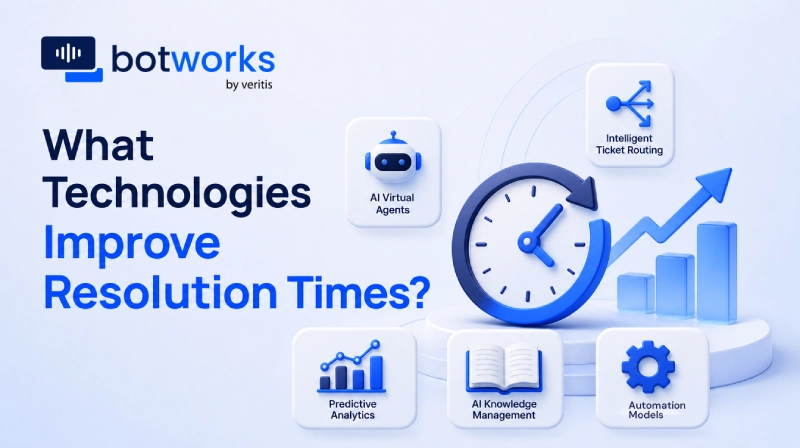
1) AI Powered Virtual Agents
AI agents for customer service handle routine queries instantly across chat and voice. They understand intent, take approved actions, and resolve issues without a queue. To see how unified chat and voice AI reshapes the customer experience, read our guide on how Chat and Voice AI improve customer experience.
2) Intelligent Ticket Routing and Classification
AI classifies incoming queries and assigns them to the right agent or flow. Faster routing means faster resolution.
3) Predictive Analytics for Proactive Support
Predictive models anticipate issues before they escalate. Teams solve problems earlier and prevent repeat contacts.
4) AI Enhanced Knowledge Management
AI keeps knowledge bases accurate and easy to search. Agents and customers reach the right answer faster.
5) Automated Workflow Execution
Advanced AI executes multi step workflows within defined business and compliance rules. It updates systems, completes approved tasks, and moves conversations toward resolution.
How Do You Measure Customer Service Efficiency?
You measure efficiency with a balanced set of satisfaction, operational, and financial metrics. No single number tells the full story.
Key Satisfaction Metrics
- Customer Satisfaction Score (CSAT): Satisfaction after an interaction.
- Net Promoter Score (NPS): Willingness to recommend the brand.
- Customer Effort Score (CES): How easy the experience felt.
Important Operational Indicators
- Average Handling Time (AHT): Time spent per interaction.
- First Contact Resolution (FCR): Share of issues solved on the first try.
Financial and Analytical Insights
- Return on Investment (ROI): Financial gains from efficiency work.
- Cost savings and revenue growth: Value created by service improvements.
Leverage Advanced Analytics
Advanced analytics reveal customer behavior, service performance, and resolution trends. These insights guide the next round of improvement. See how enterprises apply these results in our AI Customer Service Case Studies.
Real World Results: What Efficiency Gains Look Like
Enterprise teams that commit to customer service efficiency and resolution see measurable outcomes across the business.
Common results from organizations that prioritize efficiency include:
- First Contact Resolution rates rise when routing and knowledge management improve together. According to SQM Group, a 1% improvement in FCR corresponds to a 1% improvement in customer satisfaction.
- Average Handling Time falls when agents have the right information at their fingertips instead of switching between disconnected tools.
- Cost per contact drops as automation absorbs routine volume and agents focus on higher value cases.
- Customer Effort Scores improve when journeys are redesigned around the customer rather than internal workflows.
These results do not require a full platform replacement. Many enterprises achieve significant gains by closing specific gaps: better routing, smarter knowledge bases, or AI handling of high volume routine queries.
To understand the measurable business value AI agents generate, explore key considerations for deploying AI agents in customer service.
Could Efficiency Harm Service Quality?
No, when it is designed well. Poorly designed efficiency can create exactly this problem. Automated flows that lack empathy, rigid scripts that ignore context, and speed targets that punish resolution quality all damage the customer relationship.
The safeguard is design. Efficiency should reduce friction and delay, not cut the corners that matter. Key principles that protect quality include:
- Set resolution quality as a primary metric, not just handling time.
- Build intelligent escalation so complex cases always reach a human.
- Use automation where it genuinely improves the experience, not just where it cuts cost.
- Continuously review customer feedback to catch quality degradation early.
When efficiency is built around real resolution, quality and speed reinforce each other.
Conclusion: Achieving Superior Customer Service Efficiency
Customer service efficiency delivers faster resolution, lower cost, and stronger loyalty. It rests on frictionless journeys, smart automation, skilled agents, and clear metrics. Enterprises that combine these elements resolve more issues on the first contact and grow with confidence.
Botworks helps organizations take this further. It enables intelligent customer service automation across chat and voice. Botworks understands customer intent, works within defined business and compliance rules, connects with enterprise systems, takes approved actions, and escalates when human judgment is required. The result is faster resolution, lower manual effort, and measurable improvement in customer experience.
Boost Service EfficiencyFAQs: Customer Service Efficiency and Resolution
What is customer service efficiency?
Customer service efficiency is the ability to resolve customer issues quickly and accurately while using minimal time, effort, and cost.
Why is customer service efficiency important?
It raises satisfaction, lowers operating costs, and protects brand reputation. Each of these directly affects retention and revenue.
Could efficiency harm service quality?
No, when it is designed well. Efficiency removes friction and delay so agents can focus on complex cases. Quality improves alongside speed, not at its expense.
How can companies measure customer service efficiency?
Companies track metrics such as CSAT, CES, AHT, and First Contact Resolution. Together, these show both experience quality and operational speed.
What role does technology play in service efficiency?
AI, predictive analytics, and automated workflows resolve routine issues instantly and route complex ones intelligently. This improves both speed and resolution quality.
What is First Contact Resolution and why does it matter?
First Contact Resolution is the percentage of customer issues fully resolved during the first interaction. Higher FCR reduces repeat contacts, lowers cost, and directly raises customer satisfaction.
How do you keep your promises and stay consistent in customer service?
Ensure your systems and processes are reliable so every customer interaction meets promised standards, which builds trust and efficiency.