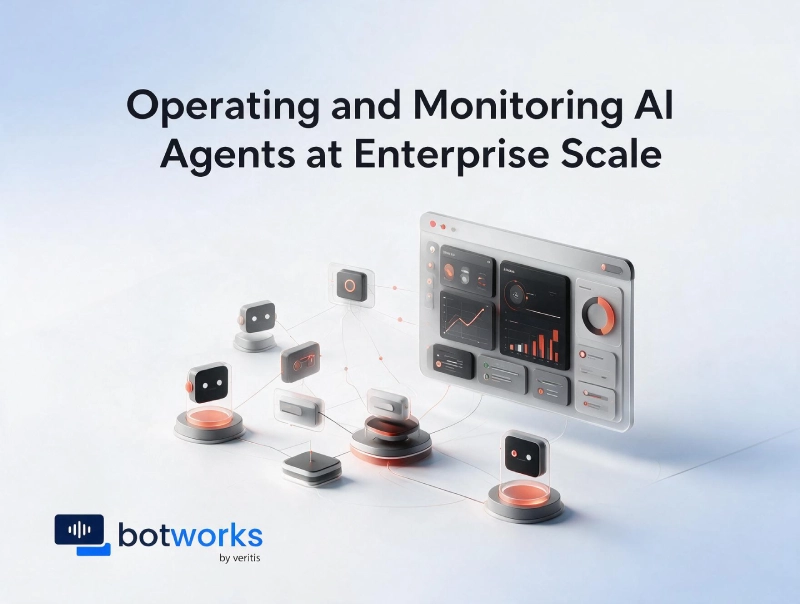
AI agent operations involve deploying, monitoring, and refining AI systems to perform tasks quickly and accurately in an enterprise setting. These operations enhance service interactions and streamline processes, requiring robust frameworks for deployment, monitoring, control, and continuous improvement.
What Are AI Agent Operations and Why Are They Essential?
AI agent operations encompass deploying, managing, and refining AI agents to perform tasks efficiently and accurately. Essential for modern enterprises, they improve customer interactions and boost operational efficiency by automating repetitive tasks and analyzing vast datasets in real time. For more insight into this complex field, consider reading about AI Agents for Customer Service: How They Work | Botworks.
Scale AI Agent OperationsHow Do You Implement AI Agent Operations at Scale?
Transitioning AI agents from pilot projects to full scale operations is a complex process that involves strategic planning and execution.
- Moving from Pilots to Production: Create strategic plans that address operational challenges as you transition from basic pilots to scalable deployments.
- Handling Interaction Volumes: Efficiently manage large scale data processing as deployments expand.
- Maintaining Context Across Interactions: AI agents must retain customer context for consistent experiences. Platforms like Botworks facilitate this.
- Coordinating Chat and Voice Agents: Align chat and voice agents for seamless customer interactions. For insights, see the helpful comparison in AI Agents vs Chatbots: What Enterprises Need to Know.
- Integrating with Enterprise Workflows: Ensure seamless integration with enterprise workflows to boost compliance and efficiency.
What is AI Agent Operations Monitoring?
AI agent operations monitoring involves observing and analyzing AI systems in action to ensure they work optimally and meet performance standards. According to AI industry reports, this process includes tracking system availability, analyzing customer interactions for accuracy, and ensuring rapid response times against predefined benchmarks.
Key Aspects of AI Agent Monitoring
- Availability and Reliability: Monitoring uptime and reliability to minimize service disruptions.
- Accuracy and Latency: Ensuring AI responses are accurate. For instance, measuring response accuracy helps in refining agent performance.
- Workflow and Interaction Observability: Continuously tracking workflows to ensure adherence to business rules and efficiency.
- Real-time Anomaly Detection: Implementing systems for immediate identification and resolution of failures.
What Are the Best Practices for AI Agent Operations Monitoring?
Visible operations are crucial for maintaining and optimizing AI agent performance. Implementing robust monitoring frameworks is key.
- Tracking Availability and Reliability: Utilize observability tools to monitor uptime across platforms.
- Monitoring Response Accuracy: Regular analysis ensures responses meet customer expectations.
- Measuring Latency and Response Times: Use metrics to optimize latency, keeping interactions swift.
- Observing Workflow Execution: Continuously track workflow execution within enterprise ecosystems for high compliance and efficiency.
- Detecting Failures and Anomalies: Implement real time systems for failure and anomaly detection.
To learn more about monitoring practices, visit AI Agent Operations Monitoring Enterprise.
Why is Governance and Control Crucial in AI Agent Operations?
Governance involves setting guidelines, managing permissions, and maintaining records to ensure compliance and security.
- Defining Approved Actions: Clearly outline permissible actions to maintain policy compliance.
- Managing Access and Permissions: Ensure only authorized personnel can influence operations.
- Monitoring Escalation Decisions: Track escalation decisions to ensure alignment with governance standards.
- Maintaining Records: Keep comprehensive records for transparency and auditability.
How Do You Measure AI Agent Performance and Business Impact?
Evaluate AI agents’ impacts through various business metrics and performance indicators.
- Resolution and Completion Rates: Track the percentage of issues effectively resolved by agents.
- Customer Experience Metrics: Utilize customer satisfaction scores as core measures of success.
- Operational Efficiency Measures: For more on efficiency improvements, see How to Enhance AI Agent Resolution for Enterprise Success.
- Business Outcome and Value Tracking: Measure impacts like revenue growth, cost savings, and competitive advantage.
What Are Agent Development and Orchestration Platforms?
Agent development and orchestration platforms provide tools to build, deploy, and manage AI agents. These platforms facilitate seamless integration with existing systems and support scalability.
Deployment Free Editions and Pricing
Tools such as Weights & Biases (W&B Weave) offer free editions for deployment testing, allowing enterprises to explore capabilities before full-scale implementation. These platforms provide transparency in pricing, ensuring clarity for budget planning.
Potential Reasons Behind Performance Differences
AI agent performance can vary significantly due to factors such as data quality, algorithm robustness, and integration efficiency. Enterprises should invest in continuous monitoring and improvement to mitigate these performance differences and optimize AI operations.
1) Tier 1: Fine-grained LLM & Prompt/Output Observability
This level focuses on the detailed analysis of language model outputs and input prompts, ensuring that AI agents produce relevant and accurate responses.
2) Tier 2: Workflow, Model & Evaluation Observability
By observing workflows and evaluating models, enterprises can ensure consistent performance aligned with business objectives. Regular evaluation helps identify areas for improvement and refine operational strategies.
How Can You Scale and Continuously Improve AI Agent Operations?
Continual refinement and scaling are critical to adapting to technological advances.
- Analyzing Conversation Patterns: Identify common issues and assess response efficacy to refine operations.
- Refining Responses and Behavior: Use feedback loops to enhance agent performance.
- Optimizing Integrations: Ensure smooth integration with enterprise systems for natural interactions.
- Scaling AI Operations With Botworks: Botworks provides scalable solutions for deploying chat and voice AI agents, integrating enterprise data, and refining performance, as noted in Botworks Voice: Cutting Wait Times by 80%.
Comparing AI Agent Operations Maturity Levels
Enterprises typically progress through identifiable stages of AI agent operations maturity. Understanding where your organization currently sits helps prioritize the next investments.
| Maturity Level | Characteristics | Typical Outcomes |
| Pilot | Single channel, limited scope, minimal monitoring | Proof of concept, limited business impact |
| Foundational | Production deployment, basic monitoring, manual governance | Improved efficiency, some CX gains, moderate control |
| Operational | Multi channel, automated monitoring, defined governance framework | Consistent resolution rates, measurable cost reduction |
| Advanced | Full observability, continuous improvement cycles, integrated analytics | High containment rates, strong business outcomes, audit ready |
| Optimized | Predictive monitoring, cross channel orchestration, real time refinement | Industry leading CX, maximum efficiency, scalable growth |
Most enterprises entering full production deployment begin at the Foundational level. Reaching the Operational and Advanced stages typically requires 12 to 24 months of deliberate investment in monitoring infrastructure, governance frameworks, and improvement processes.
In Conclusion
successfully operating AI agents at an enterprise scale requires a comprehensive approach that includes strong foundations, robust visibility, governance, performance measurement, and continuous improvement. Exploring platforms like Botworks can significantly enhance AI agent operations. For tailored advice, consider booking a consultation to assess your current environment.
Optimize AI Agent OperationsFAQs: AI Agent Operations
What are the core components of AI agent operations?
Core components include building a deployment foundation, establishing visibility and control over operations, measuring performance, and continuous refinement.
Why is maintaining customer context important in AI operations?
Maintaining customer context across interactions ensures personalized, consistent experiences that boost satisfaction and loyalty.
How can AI agent performance be effectively measured?
You can measure performance with metrics such as issue resolution rates, escalation handling, customer satisfaction scores, and business impact analysis.
What role does governance play in AI agent operations?
Governance ensures compliance with policies and controls AI agent actions, maintaining operational integrity and accountability.
How does Botworks facilitate AI agent scaling?
Botworks provides scalable solutions that integrate enterprise data and refine performance, offering tools for full scale deployment and continuous improvement.