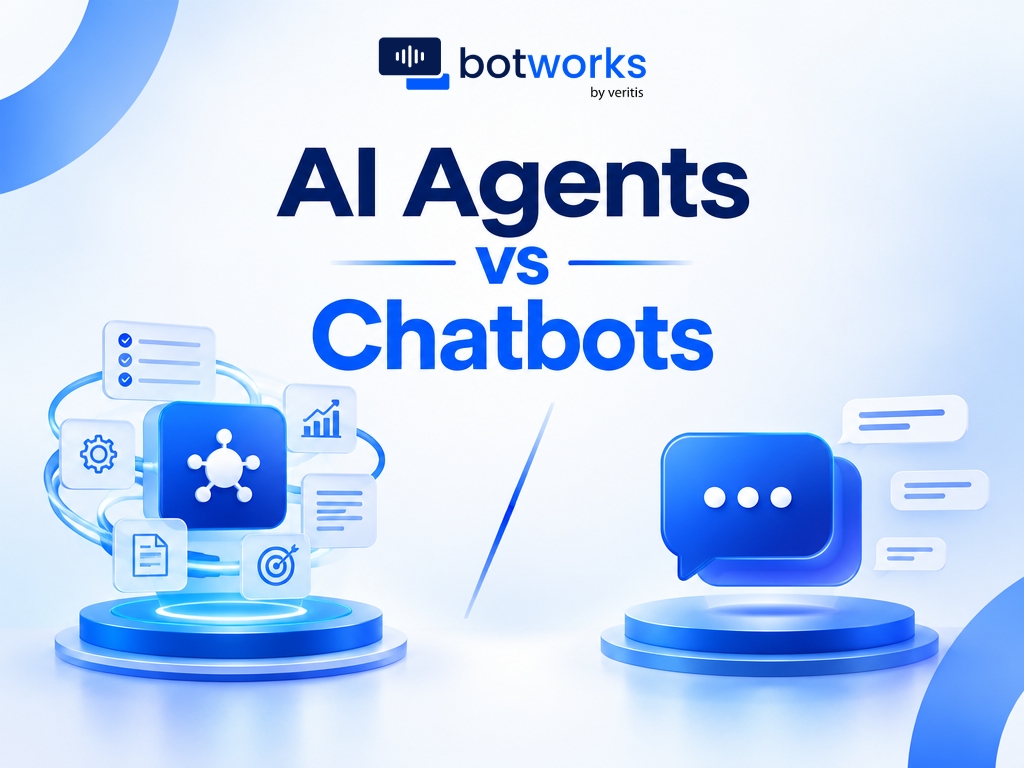
AI agents autonomously reason, plan, and execute multistep tasks across connected enterprise systems to resolve issues end to end. Chatbots follow scripts or generative prompts to answer questions and then hand off anything complex. Put simply, agents resolve while chatbots respond. This difference now shapes how enterprises invest in customer service automation. By understanding the unique strengths of each, business leaders can choose the tool that best supports their customer service goals.
Why This Distinction Matters Now?
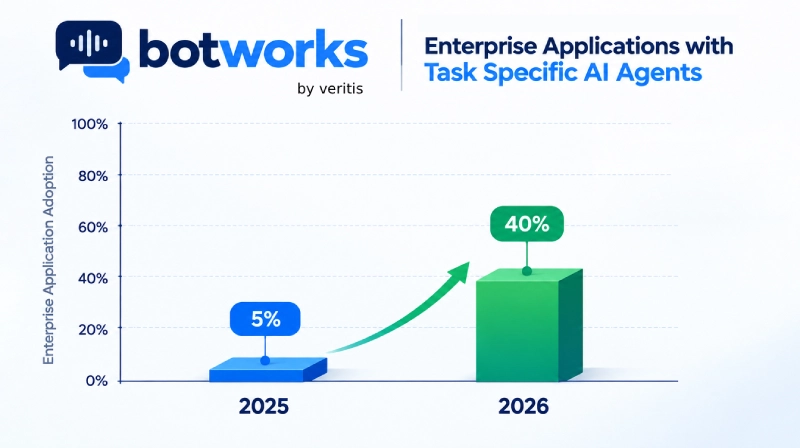
The market has crystallized around one idea in 2026: automation is judged by resolution, not conversation. According to Gartner, 40% of enterprise applications will integrate task specific AI agents by the end of 2026, up from fewer than 5% in 2025. Additionally, companies like Zendesk and Salesforce have introduced AI agents that can automate up to 80% of service workflows (Source: Gartner). This trend signals a shift toward multichannel engagement and voice capable AI, improving customer satisfaction and reducing operational costs compared with traditional chatbots.
Real world results are still maturing. Current self service resolution rates sit between approximately 14% and 50% for routine tasks, with the widely cited 80% resolution figure being a projection for 2029 (Source: Gartner). The lesson for enterprise leaders is straightforward: agents are advancing rapidly, but their capabilities must match the task.
Explore AI Agent SolutionsWhat is a Chatbot?
A chatbot is a digital tool that communicates with users through text or voice. It provides information, answers questions, or guides simple interactions. Chatbots typically follow predefined rules or use generative models. They help with FAQs and specific guidance but lack autonomous task execution and long term context.
What is a Rule Based Chatbot?
A rule based chatbot uses a predetermined decision tree. Designers map out questions, keywords, and branching paths in advance. The bot matches user input to a scripted response.
How Rule Based Chatbots Work?
- A user types or speaks a request.
- The bot matches keywords or menu choices to a rule.
- It returns the scripted answer tied to that rule.
- Anything outside the script triggers a fallback or a handoff.
This design’s speed, predictability, and low deployment cost make it suitable for repetitive queries.
Limitations of the Rule Based Architecture
- Limited autonomy: Relies on scripts, lacking independent action.
- No lasting memory: Holds only session context, forgetting past interactions.
- Brittle at the edges: Unexpected phrasing can disrupt flow.
- No system action: Cannot process refunds, update records, or complete workflows.
What is an AI Agent?
AI agents are goal oriented systems. They autonomously select, sequence, and execute tasks to achieve an objective. Agents connect to systems through tools and APIs and maintain persistent context across tasks, reducing the need for human input.
How AI Agents Work?
An AI agent operates in a loop beyond the capability of a chatbot:
1) Understand the goal: Interprets customer intent, not just keywords.
2) Plan the steps: Breaks the goal into an ordered set of actions.
3) Take approved actions: Calls tools and systems like CRM, ERP, and ITSM.
4) Check the result: Reads outcomes and adjusts the next step.
5) Resolve or escalate: Completes the task or routes to a human when judgment is required.
What is Agentic AI?
Agentic AI is the broader category behind these systems. It describes software that can reason, plan, and act toward a goal with limited supervision. Agentic AI often coordinates several agents, tools, and workflows together. In practice, the system pursues an outcome rather than waiting for the next prompt.
AI Agents vs Chatbots: A Side by Side Comparison
| Dimension | Chatbots | AI Agents |
| Core behavior | React to input | Act toward a goal |
| Autonomy | Low, prompt by prompt | High, plans and executes |
| Memory | Session based | Persistent across tasks |
| System actions | Retrieve information | Execute approved workflows |
| Integration | Limited | Deep across CRM, ERP, ITSM |
| Escalation | Basic handoff | Intelligent, context aware |
| Cost and complexity | Lower, simple architecture | Higher, sophisticated architecture |
| Best for | FAQs and quick guidance | End to end resolution |
Key takeaway: Chatbots are the right fit for simple, high volume answers. AI agents earn their cost when work spans multiple systems and steps..
Reasoning, Subagents, Instructions, and Actions
Understanding these elements helps leaders make better deployment decisions for enterprise AI agents.
1) Reasoning
AI agents use large language models to evaluate context, weigh options, and choose a path. This process sets them apart from rule based systems, allowing agents to think through problems instead of following scripts.
2) Subagents
Subagents are specialized agents that handle defined slices of a task. This keeps the architecture modular and auditable. For instance, a customer service agent might delegate identity verification to one subagent and order lookup to another.
3) Instructions
Instructions define an agent’s operational boundaries, including accessible systems and readable or writable data. These instructions allow enterprises to maintain control while preserving autonomy.
4) Actions
Actions are the steps the agent executes, such as calling an API or triggering a refund. Actions follow the established instructions, enabling secure, autonomous operations at enterprise scale.
Together, these components form the operating architecture of an enterprise AI agent. Reasoning drives decisions, subagents distribute work, instructions set boundaries, and actions produce results.
A Note on Terminology
Market labels often overlap, and vendors use them loosely. A “smart chatbot” isn’t an autonomous agent. The practical question is whether the system can complete an approved task or simply reply. The answer defines your investment.
Enterprise Applications with Task Specific AI Agents
How Do Their Costs and Limitations Compare?
Chatbots are easier to deploy and cheaper but limited by scripts and short memory. AI agents require advanced architectures and ongoing oversight, leading to higher costs and complexity. Successfully implementing AI agents involves understanding ROI and the business value they offer before full deployment.
Why Governance is the 2026 Differentiator?
Governance has become the primary concern for enterprises. The EU AI Act mandates auditability and human oversight for high risk systems. Gartner warns that over 40% of agentic AI projects may be canceled by 2027 because of inadequate risk controls, unclear ROI, and rising costs. The lesson: autonomy without control is a liability.
BotWorks operates by understanding customer intent, adhering to business and compliance roles, connecting to systems, taking approved actions, and escalating intelligently as required.
How to Build an AI Agent?
You don’t need to start from scratch:
- Define the outcome: Identify the end to end customer issue to be resolved.
- Map the systems: Identify the CRM, ERP, or ITSM the agent must access.
- Set the guardrails: Establish approved actions, permissions, and escalation rules.
- Connect and test: Integrate tools and run tests in a sandbox environment.
- Measure resolution: Track resolution rate, handle time, and customer satisfaction.
1) Build Agents Fast
Modern platforms enable quick launches with prebuilt integrations, managed sandboxes, and permission controls.
2) Get Expert Guidance
Enterprise success depends on aligning strategy, integration, and governance. Partnering to scope goals, securely connect systems, and prove early ROI is key. AI Agents Value in Customer Service: ROI and Examples
Conclusion
Enterprise leaders should align tools with outcomes. Chatbots deliver cost effective, practical answers for simple interactions. AI agents, though more complex and costly, resolve issues across connected systems. Assess objectives, integration needs, and security requirements to select the technology that yields measurable results.
To deploy secure, governed AI agents that resolve customer needs across Chat and Voice, book a consultation with BotWorks.
Explore AI Agent SolutionsFAQs: AI Agents and Chatbots
What is the primary difference between AI agents and chatbots?
AI agents autonomously plan and execute tasks to resolve issues, while chatbots react to inputs and answer questions without independent action.
Are AI agents more expensive than chatbots?
Yes, AI agents are generally more costly because of their advanced architecture and integration, but they provide higher resolution and reduce manual workload.
How do AI agents handle context differently than chatbots?
AI agents maintain context across interactions and manage complex workflows, while chatbots hold only session based context.
Can AI agents replace human agents?
Not fully. Well governed AI agents handle routine tasks and escalate when human judgment is needed, allowing teams to focus on higher value work.
What is agentic AI?
Agentic AI is software that reasons, plans, and acts toward goals with minimal supervision, coordinating multiple agents, tools, and workflows.